The Categorical Imperative: Grothenpuhh, Grifters, and the Logic of Math-Meme Culture
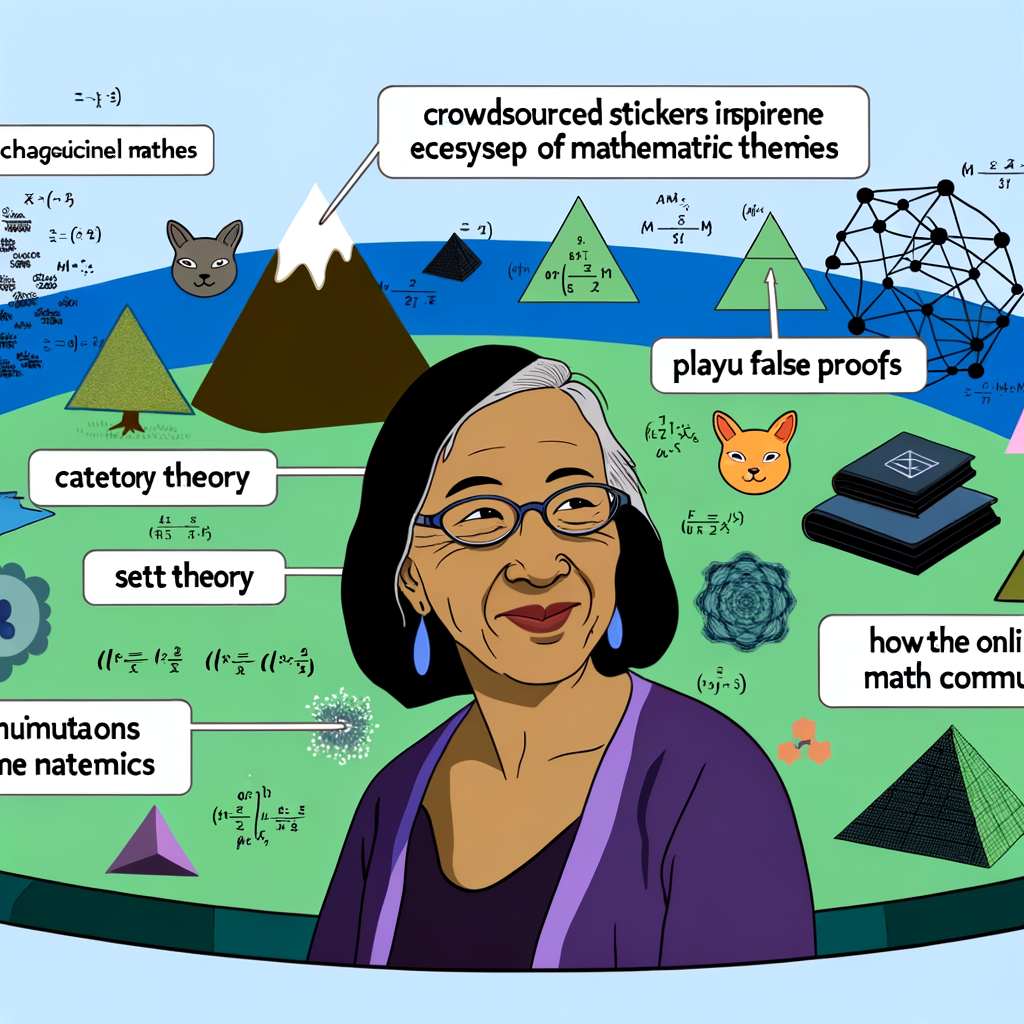 # The Categorical Imperative: Grothenpuhh, Grifters, and the Logic of Math-Meme Culture
There is a tiny universe where algebraic geometry meets Photoshop, and its citizens are equal parts brilliant, petty, and unreasonably devoted to stickers. Picture a Discord server where someone suggests turning Alexandre Grothendieck into a femme sticker mascot named Grothenpuhh. It is simultaneously adorable, slightly sacrilegious, and exactly the kind of thing that makes a forum feel alive.
But that playful nexus — inside jokes, crowdsource art, and the occasional tone-deaf template — sits beside a grimmer engine: accounts that harvest community humor and sell it back as content, and a steady parade of one-line refutations of Cantor, Fermat, and anyone else who has the misfortune of being famous. Let me walk you through the algebraic and logical anatomy of this ecosystem, half laughing, half smirking, and wholly convinced it’s worth caring about.
## Stickers, commons, and the logic of participation
The sticker contest is a delightful microcosm of collaborative creative commons. One user pitches an idea, admits they cannot draw, and offers a small, silly bribe — Discord Nitro — to get people to riff. Designers show off, newcomers participate, and the server acquires a bespoke emblem people actually use.
From the perspective of category theory, this feels like a small but telling adjunction between creators and community. Objects are contributions, morphisms are the edits and riffs, and the universal property we want is that the resulting sticker represents the community in a way that respects contributors. When that universal property fails — say a repost aggregator rips the art and pants it with an ad — the adjunction collapses into something uglier: a monoid of take, take, take.
There is also a social logic here. Commons-based collaboration thrives when incentives align with attribution and recognition. In math communities, recognition is often the currency; it is how people build reputation, mentor, and get invited to collaborations. A sticker contest may seem trivial, but it reinforces norms: contribute, remix politely, and expect your work to circulate within the network, not be siphoned off to strangers who monetize without credit.
## Grifters: ethics, network effects, and practical response
Reposting accounts are a feature of the attention economy, not a bug. They rely on a simple network-theoretic fact: content that originates in many low-degree nodes can be aggregated by a high-degree node and amplified. Ethically, this feels disgusting — especially when revenue flows back to the aggregator and not to the originators.
But there are two sides. One can argue that aggregation increases reach, occasionally bringing talented unknowns into contact with audiences they never would have reached otherwise. The counterargument is that the value extracted rarely returns to creators, and worse, it weakens the norm of attribution.
For individuals who want to act: don’t click the aggregator, downvote reposts, report when appropriate, and favour platforms or accounts that credit originators. For communities, build small technical and social barriers: visible watermarks, community-run repost accounts that share ad revenue or tips, and cultural shaming of serial thieves. These are imperfect defenses, but they act like immune responses in a healthy online organism.
## Bogus proofs: sport, pedagogy, and epistemic hygiene
Ah, the bogus proof. The classic structure is familiar: take a canonical theorem, assert a short refutation or simplification in half a dozen lines, and watch the comment thread oscillate between awe and evisceration. Sometimes it is playful: a reductio ad absurdum presented as a joke. Sometimes it is dangerous: a genuinely misleading sketch that spreads confusion.
From the standpoint of proof theory, bogus proofs are interesting. They often exploit category-theoretic sleights of hand, hide quantifier shifts, or smuggle nonconstructive steps into an apparently constructive argument. To the untrained eye, the argument looks elegant; to an expert it is a leak of a crucial hypothesis.
This is where community epistemology matters. Math memes lower the intimidation barrier: they invite nonexperts into conversations about infinity, equivalence, and structure. That is a net good. But enjoying the spectacle requires an epistemology helmet: appreciate the wit, ask for rigor, and welcome corrections. The best threads are those with both jokers and patient explainers — the ones who can make the logic visible without killing the fun.
## Cross-disciplinary reflections: set theory, model theory, and complexity
The ecosystem reflects the cross-sections of math itself. Set theory’s obsession with size and paradox maps nicely onto debates about reach and copyright: who gets to claim a set of memes as theirs? Model theory’s concern with structures and interpretations echoes how a meme can have multiple readings across subcultures. Complexity theory? That’s the ad auction: cheap-to-produce content that scales poorly for creators but efficiently for aggregators.
Category theory enters again as a meta-language. It encourages us to think about morphisms between communities, functors that preserve structure (credit, attribution), and natural transformations that can convert a culture of theft into one of shared reward. It is cheeky, but useful: abstract patterns give us tools for practical repair.
## Enjoy the absurdity, defend the commons
The theatre of math memes is worth keeping. It demystifies hard ideas, humanizes mathematicians, and nourishes a culture of playful rigor. But like any ecosystem, it is vulnerable to parasites. Grifters who monetize without credit and bogus proofs that mislead without correction are real harms.
So what do we do? Participate, annotate, correct with kindness, and withdraw attention from exploiters. Build norms and small technical fixes where possible. Value attribution as a first-order principle. If you are the person with a million followers who reposts, ask yourself: what are you adding besides ad inventory? If you are the person with the sticker idea, claim your culture, but listen when someone points out tone problems.
I love that Grothenpuhh exists. I enjoy the clever punning about Cantor and the ridiculous propositions that get shot down in the comments. I am also a little prickly about content theft. That balance — equal parts joy and vigilance — feels like the categorical imperative of a healthy math-meme community.
So here is the question I leave you with, because I am nosy and slightly mischievous: how do we design small category-theoretic or algorithmic interventions that preserve the playfulness and accessibility of math memes while making it harder for attention parasites to monetize without giving back?
