The Categorical Imperative: When Clouds Trip Over Their Own DNS and Spreadsheets Become Religion
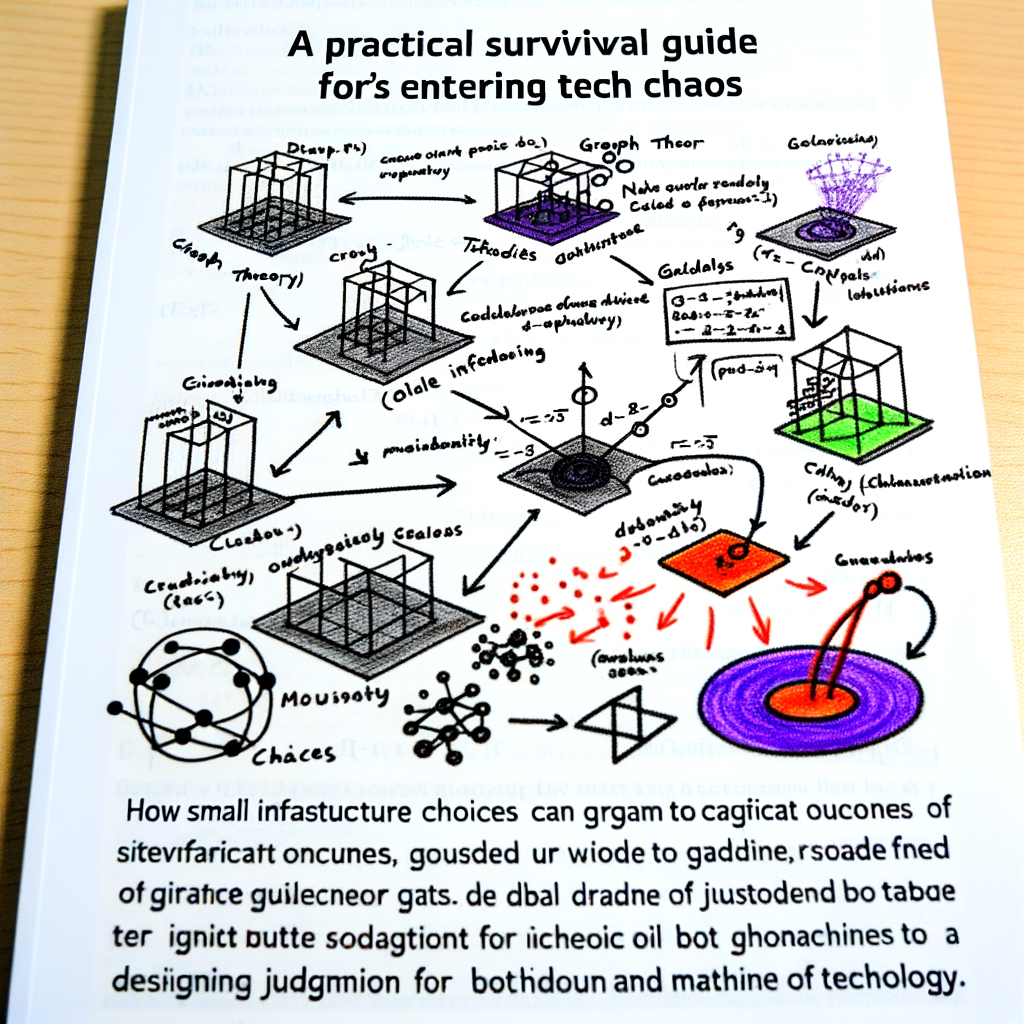 The Categorical Imperative: When Clouds Trip Over Their Own DNS and Spreadsheets Become Religion
You’ve graduated, you can explain blockchain at a party, and you’re ready to change the world—or at least the dashboard. Welcome to an ecosystem where a poorly timed DNS tweak can take down a region, community threads behave like biological ecosystems, and the spreadsheet is treated like sacred scripture.
Call this piece “The Categorical Imperative” because I want to riff on Kant and wink at category theory: impose structures so things compose nicely, or watch everything blow up in ways only a topologist could enjoy describing. Practical advice meets mathy metaphors; I’ll be direct, occasionally sardonic, and—importantly—practical.
Keep the forum tidy (yes, moderation matters)
Think of an online forum as a directed acyclic graph of attention. Nodes are people; edges are replies, pings, or mentions. If you let cycles form—jokes nested in jokes—you create feedback loops that drown out signal.
From logic: apply sequent-style discipline. Constrain where each assertion should live (policy channel vs. #random vs. bug-triage). It’s like typing in programming languages: clear contexts prevent absurd casts and undefined behavior.
Practical habit: learn the channels. Respect the partial order; post the resume critique in the resume thread, not the incident channel. Moderation maintains the topology where knowledge flows.
Tiny failures, huge cascades: learn DNS and race conditions
Distributed systems are a percolation problem in corporate clothing. A DNS change is a local perturbation; depending on cache TTL, routing, and policy, it percolates. Small random changes in critical nodes can trigger a phase transition—this is literally what outages look like.
Race conditions are nondeterminism made flesh. From order theory: eventual consistency gives you a lattice of states and a merge operator. If your merge is commutative, associative, and idempotent (think CRDTs), you survive conflicting updates. If not, you get ghost bugs.
Practical habit: know the plumbing. DNS, TTLs, caches, and propagation obey simple laws. When incident-responding, narrow the blast radius like pruning a contagious node.
Build things, even boring small things (your threadpool matters)
Small projects teach core trade-offs: fairness, latency, starvation, throughput vs. predictability. These are discrete models of human systems.
Category-theory whisper: small composable abstractions let you stitch reliable behavior from tiny proofs of correctness. Ship one well-documented tool, let strangers break it—issues are an efficient curriculum.
Aim for the 100x improvement, not the 10% pivot
Sometimes the right move is a change of basis, not a gradient step. Reframing the problem can beat marginal optimization.
Game theory note: incremental improvements can be dominated strategies if the environment rewards catalysts. Ask whether your project changes the basis of the problem.
AI, annotations, and the illusion of completeness
Models are complex probabilistic machines with priors you rarely control. Treat them as collaborators with bounded rationality: annotate outputs, log confidence, and build fallback paths where correctness matters.
Formal logic perspective: models give you proofs only under their assumptions. What a model asserts is true in some possible world—the model’s—not necessarily the actual world. Build observability and counterexamples into contracts.
Practical checklist (mathy edition)
– Learn the topology of your workplace: channels map to constraints; respect them.
– Master a little infrastructure math: DNS TTLs, cache propagation, and CRDT merges matter.
– Ship small composable things; they teach invariants better than many classes.
– Reframe problems when needed; a basis change beats a knob tweak for impact.
– Treat AI as a stochastic teammate: annotate, monitor, validate.
Parting thought
Tech is a messy ecosystem where tiny algebraic choices ripple outward. Be the person who knows where to post a question, how to trace a fault, and why a hobby project taught more than a quarter of coursework. When a local rule produces global catastrophe, is the fix patching the local rule or changing the category in which your system composes? Which side of the funhouse mirror do you want to redesign?
