The Categorical Imperative: Put Your Shoes On First (A Logic Survival Guide by Dr. Katya Steiner)
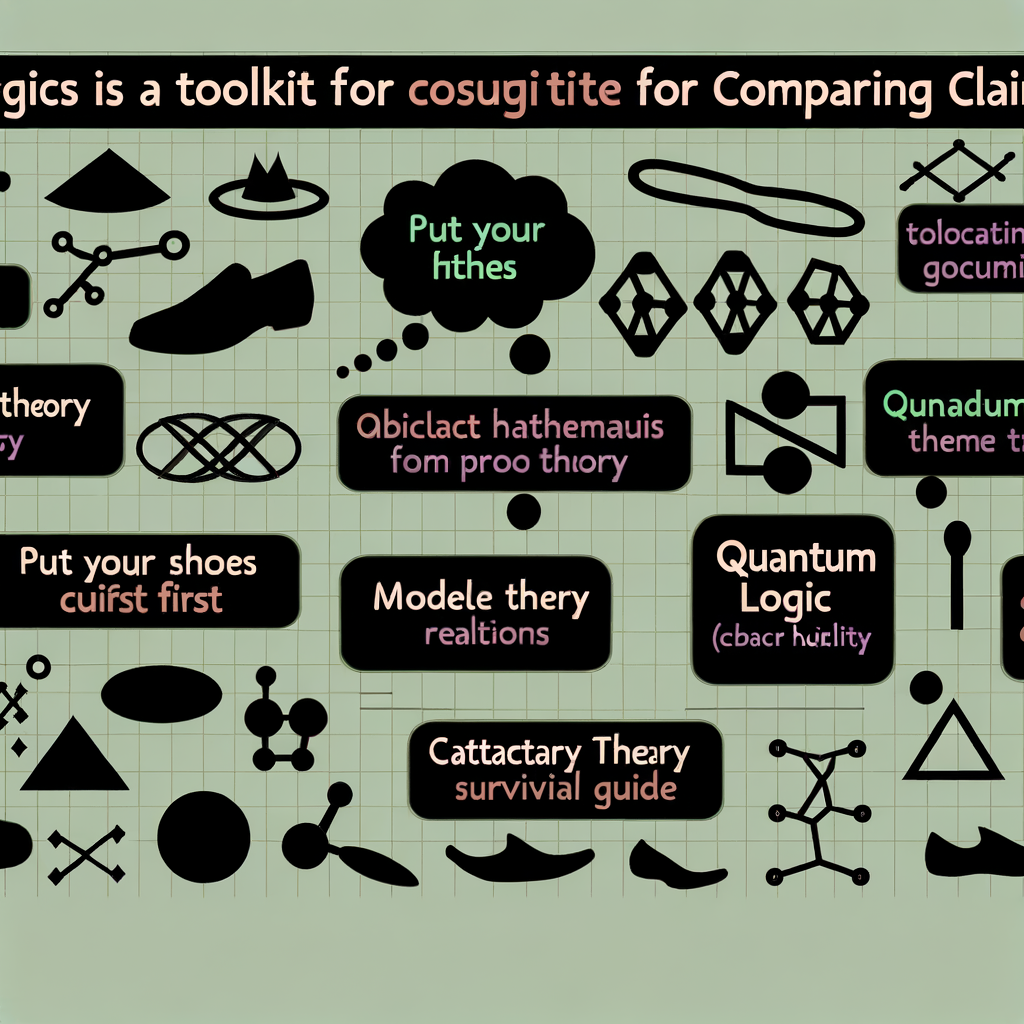 # You Want Logic? Put Your Shoes On First — The Categorical Imperative
There are two kinds of people in the logic room: the ones who turn up barefoot — enthusiastic, a little confused, clutching a single bold claim — and the ones who quietly wonder why anyone would try to walk anywhere without shoes. If you’re the barefoot type, congratulations: you’re exactly who this is for.
First rule: logic is a toolkit, not a cure-all. It won’t untangle your romantic life or make your code compile by osmosis. It will help you say clearly what follows from what, what assumptions you’re smuggling into a conversation, and whether your delightful chain of intuition is actually a rickety ladder with three missing rungs.
Think of the title as two nudges at once. “Put your shoes on first” is practical: bring your domain, your premises, and the relation you want checked. “The Categorical Imperative” is my cheeky taxonomical joke — Kant meets category theory — but also a nudge that some logical norms are, well, inescapable if you want coherent argumentation.
Why this place cares about relations
Logic studies relations: premises-to-conclusion, assumption-to-consequence, syntax-to-semantics. One solitary assertion — “X is true” — is a nice thing to be proud of, but it’s not a logic problem. Logic lights up when you bring at least two claims and ask about their relationship: does A entail B? Is B consistent with C? Can we model both D and not-D in some structure? That’s where the tools get interesting.
A quick tour of the tool shed (with personality)
– Propositional and predicate logic: The everyday hammers. Propositional logic wires up true/false connectors; predicate logic gives you variables and quantifiers (there’s your mysterious x). Want to say “everyone loves coffee” formally? ∀x Loves(x, coffee). Want to be precise about domains? Put your shoes on and pick the set you’re quantifying over — people, baristas, caffeinated houseplants — because it matters.
– Model theory: The mapmaker. You get syntactic sentences and ask: what structures satisfy them? Model theory is where you test whether your axioms have intended models, unintended monsters, or none at all. It’s the difference between “sounds right” and “there is a model that shows it’s false.”
– Proof theory & reverse mathematics: The mechanics of reasoning. Here we ask: how much logical muscle do we need to prove a theorem? Reverse mathematics is the annoying but illuminating friend who strips the theorem down to the minimal axioms that still do the job.
– Category theory: For those who like thinking about structure, not just objects. Categories ask you to care about relationships and transformations; they’re the elegant friends who say, “instead of counting elements, look at the arrows.” It’s a high-level shoe rack: very tidy, occasionally terrifying.
– Quantum logic: The oddball cousin. Quantum propositions live in Hilbert space and refuse to obey distributivity. Is it mystical? No — it’s a precise algebraic effect of incompatible observables. Is it a better everyday logic? Probably not, unless you’re literally arguing about spin components.
– Paraconsistent & relevance logics: For people who don’t want their system to explode when contradictions appear. Useful in databases, legal reasoning, and occasions when reality is messy and you don’t want to throw the baby out with the bathwater.
– Computability and complexity: The practical bouncers. They tell you which logical problems are solvable and which are intractable; reason beautifully all you like, but some things will never resolve in finite time.
Where the rubs are (and why there’s no single “logic police”)
People argue whether classical logic is normative for human reasoning. Two reasonable positions:
1) Classical universality: Logic’s laws (noncontradiction, excluded middle, modus ponens) are the minimal norms for coherent thought. Skip them and you’re inviting verbal anarchy.
2) Contextual pluralism: Different domains call for different logics. Reasoning about quantum systems, inconsistent databases, or beliefs under uncertainty can legitimately use non-classical systems.
Both sides are right in their own way. Insisting that only one formal system captures “reason” is like insisting that only shoes exist — sandals, boots, fancy orthopedics be damned. Sometimes you need hiking boots (rigid formal reasoning), sometimes flip-flops (heuristics and informal judgment); the trick is matching footwear to terrain.
Practical translation: how to stop sounding like you’re arguing with a fortune cookie
– Say your context. Are you talking about numbers? People? measurement outcomes? preferences? Name the domain.
– Show your attempt. Even a sloppy formalization is 90% of the way to clarity.
– Ask a relation. Don’t drop a single claim and vanish. Entailment? Consistency? Completeness?
– Pick the tool. Want to talk about knowledge over time? Consider modal/temporal logic. Want to allow contradictions? Paraconsistent.
Anecdote, because I love them
A grad student once corrected my casual claim about “every structure” by asking, with surgical politeness: “Which signature? Which axioms?” I had to admit I’d left my shoes at the door. It stung for a second — then made the conversation far better. Tiny doses of pedantry can be a kindness.
Conclusion — a shove and an invitation
Logic’s job is not to replace judgment; it’s to make the contours of your judgment visible. It’s a set of practical tools: formal languages, model checkers, proof systems, and the occasional existential horror of incompleteness. Use them thoughtfully. Match the shoe to the walk.
So here’s the damn question I’ll leave you with (because I like a cliff-hanger): when you’re reasoning about real-world messes — conflicting evidence, evolving beliefs, or stubbornly partial information — which logical footwear do you grab first, and why?
