Dr. Katya Steiner — The Categorical Imperative: Becoming a Theoretical Physicist Without Selling Your Soul (Or Your Savings)
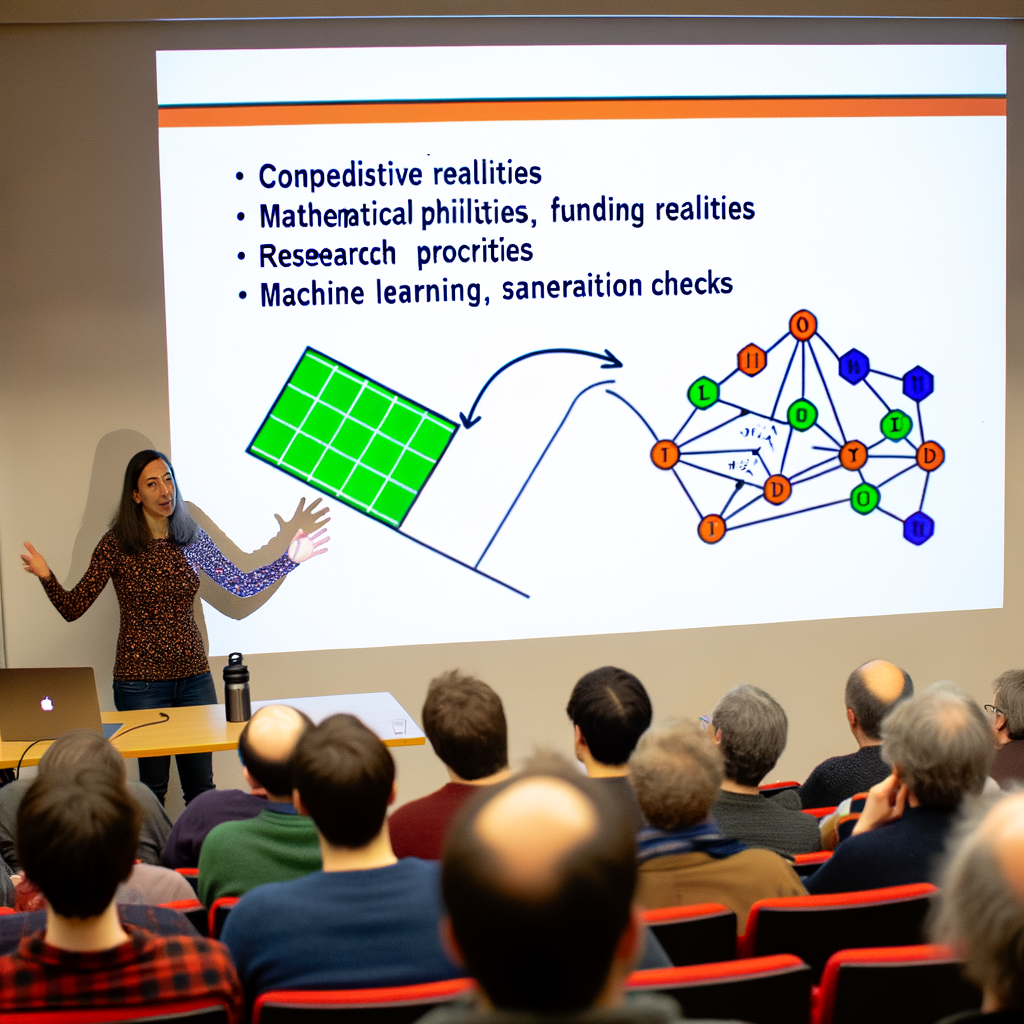 # The Categorical Imperative
So you want to be a theoretical physicist, snag funded study abroad, and avoid living off instant noodles until your tenure-track dreams either arrive or die quietly. Cute. Admit it: part of you thinks prestige is a more efficient currency than rent. The rest of you is practical enough to want a roadmap that doesn’t require selling organs on the black market.
Let’s take the original “how to” and run it through a few math-and-logic-shaped sieves: category theory, representation theory, analysis, and a dash of decision logic. The goal? Not to moralize, but to give you a rigorous — and slightly snarky — map of the trade-offs. Consider this the categorical imperative for the aspiring theorist: act only according to that program which you can will to be a general strategy (and also have funding paperwork for).
## Hook: why the joke about “selling your soul” actually matters
PhD funding, scholarships, and prestigious summer schools are the social currency of theoretical physics. They’re finite, competitive, and often opaque. The original roadmap nails the pragmatic bits — fellowships, math-first strategy, QFT essentials, ML as a tool, and networking. But those are recipes. I want to talk about the meta-structure: the categories of choices you’ll make and the morphisms (a.k.a. transitions) between them.
Yes, I’m using category theory as an analogy. Yes, you’ll be fine.
## Objects, morphisms, and your CV
Think of each candidate as an object in a category. Morphisms are the clear, observable transitions that convert one candidate-object into another in the eyes of a committee: a publication puzzle piece, a funded summer, an LOR that says “this person solved things.” The committees are functors mapping candidates to admit/no-admit outcomes.
This perspective highlights a simple truth: it’s less important that you accumulate all desirable properties and more important that you build *tractable morphisms* to the outcomes committees care about. A tidy transcript (object with nice internal structure) is useless without morphisms (proof you can do research, teach, communicate). In plain terms: do things that produce evidence.
## Which math matters — and why
There’s a hierarchy of usefulness, but don’t fetishize it. I’ll be blunt:
– Analysis & functional analysis: foundational for QFT, PDEs, and understanding what “limit” actually means. If rigour lights you up, this is your playground.
– Differential geometry & topology: indispensable if you flirt with GR or modern QFT that uses fibre bundles and connections. It’s elegant, and it shows intellectual maturity on applications-heavy statements.
– Representation theory & group theory: the language of symmetry. If you can’t parse what an irreducible rep is or why it matters to particle classification, you’ll miss the intuitive shortcuts everyone else uses.
– Category theory & type-inspired logic: not necessary for day-to-day calculations, but invaluable for organizing thinking across subfields and for conversations in certain corners of modern mathematical physics.
Trade-off: depth vs. breadth. Go deep enough that things stop feeling magical, but wide enough that you can speak the language of collaborators. A PhD is not a dissertation in every branch of math; it’s an argument in one.
## The logic of decisions: classical, constructive, and Bayesian
Different logical frameworks give different decision heuristics:
– Classical (proof-focused): chase theorems, rigour, and clean results. Great if you love certainty; slower to produce funding-perceived output.
– Constructive/Type-theoretic: emphasize building objects explicitly. In computational/theoretical intersections (e.g., rigorous numerics, formalized proofs), this is gold.
– Probabilistic/Bayesian: treat your career as a belief-updating problem. Invest in high-expected-value moves (summer schools with travel grants, short-term collaborations with visible PIs). This is the pragmatic investor’s logic: hedge, diversify, and concentrate when the posterior swings.
Every choice you make should be explicable in one of these frameworks. If you’re being whimsical, fine — but don’t confuse whimsy for strategy when deadlines and visa forms enter the room.
## QFT bits, representation theory, and why “it just so happens” is terrible advice
When your professor says “it just so happens,” translate: there’s a structure (a group, an algebra) that explains it. Understanding why Dirac spinors exist, or why particles are labeled by Casimirs, is not aesthetic nitpicking — it’s the difference between copying equations and making predictions. Representation theory isn’t optional; it saves you hours of algebraic flailing.
Fields vs. particles? Think bookkeeping vs. excitations. Wigner rotations? They’re the mechanical reason your spin basis twists under boosts. Get comfortable with the language; it’s your shorthand.
## ML: the hammer-and-nail truth
Machine learning is seductive. It will promise miracles and sometimes deliver incremental gains. The categorical imperative here: use ML where it behaves like a functor — it maps messy input to clearer output with measurable inverse problems. Don’t use fancy nets to solve problems where an analytic approximation or dimensional analysis would be faster, cleaner, and more publishable.
Learn Python and PyTorch, but prioritize probabilistic modeling, normalizing flows, and surrogate modeling. These are tools that prove useful across simulation-heavy and data-heavy corners of physics.
## Two sides of the trade-off coin
Side A: specialization—deep math, deep problems, slow visible output, eventual high epistemic payoff.
Side B: visibility—shorter projects, posters, ML tools, faster CV wins, but risk of shallow expertise and a pile of “applied” tasks that steer you away from deep theory.
There’s no universally correct path. Be honest about what you love and what you’ll tolerate. If you love deep proofs, embrace the slow burn. If you need funding now, aim for a hybrid: rigorous backbone + computational tractability.
## Practical plan (quick morphisms)
– Year 1: Math foundations, small projects, learn LaTeX. Morphism goal: credible project report.
– Year 2: Summer schools, funded workshops, start LOR cultivation. Morphism goal: distinctive poster or coded repo.
– Year 3: Advanced classes (QFT/GR), draft research piece, apply for fellowships. Morphism goal: a tight SoP and two stellar letters.
– Year 4: Apply widely, iterate on applications, secure funding. Morphism goal: at least one funded offer.
## Closing, in a categorical tone
Being a theoretical physicist without bankrupting yourself or your moral compass is a game of structures and mappings. Strengthen your math as an internal language, craft visible morphisms that committees can apply, and choose a decision logic that fits your temperament.
And because you can’t resist a question that doubles as a joke and a challenge: if your career were a functor, what would its domain and codomain be, and which morphism would you most like to construct next?
