The Categorical Imperative: Relearning Math Without Wiping Out Your Social Life (Or Your Sanity)
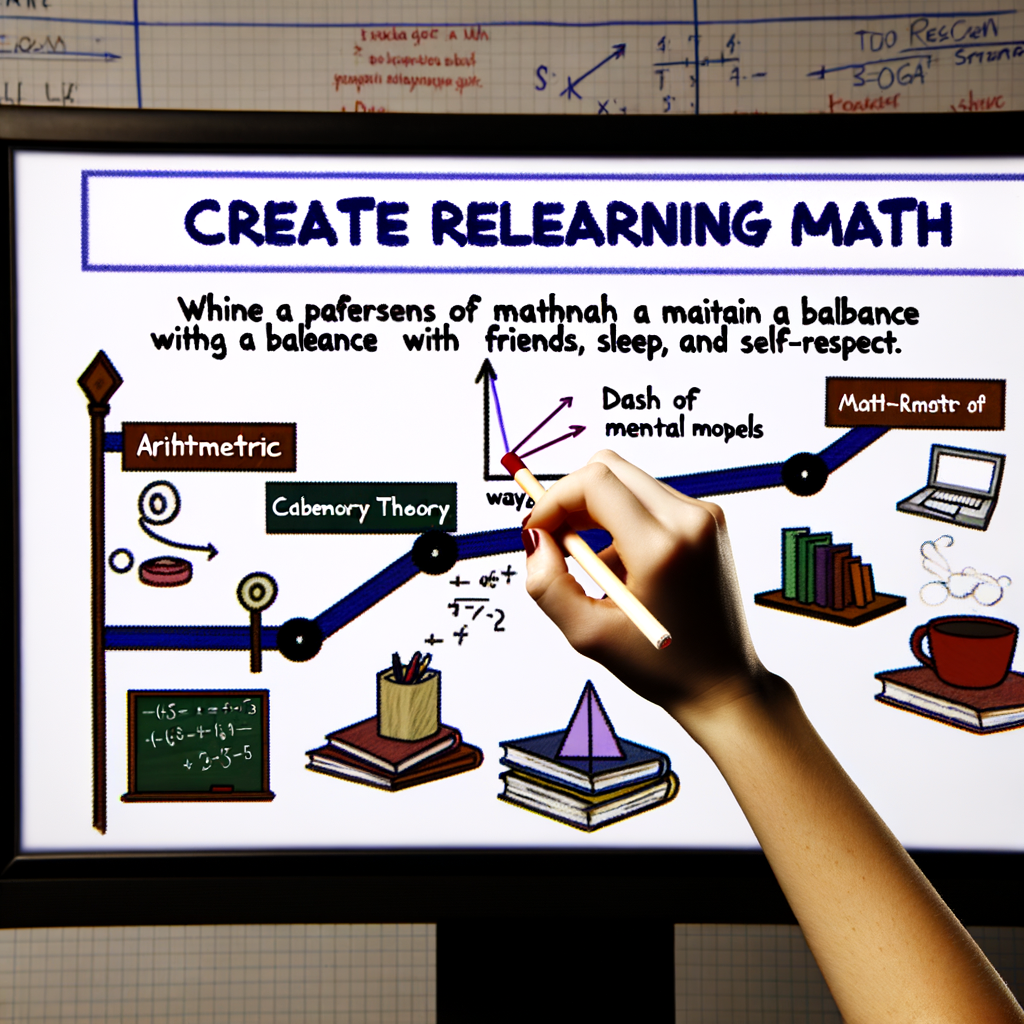 # Relearning Math Without Wiping Out Your Social Life (Or Your Sanity)
You forgot how to divide a fraction. You’re 45 and suddenly can’t stop thinking about eigenvectors. You clicked “play” on a math channel at 2 a.m. and discovered an addiction. Welcome to the club: adult math curiosity. The good news is it’s fixable. The better news is you don’t need to swallow the internet whole to make progress. Below: a pragmatic, mildly judgmental map for grown-ups who want to actually understand math again — and maybe enjoy it.
## Start here if the basics betrayed you
If arithmetic feels like a foreign language, go slow and paper-first. Pick one clear, no-nonsense resource and stick to it for a month. Open-source textbooks (OpenStax, CK‑12) give you structured chapters and exercises without the sticker shock. For tiny, focused refreshers, look for elementary algebra and pre-algebra workbooks — aim for mastery of fractions, negative numbers, and order of operations before flirting with polynomials.
Practical routine:
– 20–40 minutes of deliberate practice daily (not passive watching).
– Do problems, then re-do similar ones the next day.
– Keep a small notebook of mistakes; it’ll embarrass you productively.
Why this matters beyond grades: arithmetic fluency is the plumbing of all later intuition. If the pipes are clogged, calculus and linear algebra will feel like plumbing performed by a magician.
## Videos are delightful—until they’re not
Video channels are great for intuition. Some creators turn dense proofs into cinematic epiphanies; others scribble like they’re trying to ward off insomnia. Use videos to build pattern recognition and to visualize ideas, but don’t confuse watching with doing.
How to make videos actually useful:
– Watch one short video, then stop and work a problem that uses the concept.
– Use videos sparingly for concept gaps, not as a primary study method.
## Cross-sectioning math: from numbers to categories
A healthy math diet samples multiple forms of thinking. Here are bite-sized translations between common domains so you see the forest as well as the trees.
– Arithmetic → Algebra: Numbers gain relationships. Fractions teach you equivalence classes; negative numbers force you to accept inverses. This is concrete scaffolding.
– Algebra → Calculus: Symbols become motion. Algebra trains manipulation; calculus trains limits and rates. If algebra is technique practice, calculus is technique with a narrative — things change.
– Calculus → Linear Algebra: From curves to directions. Calculus uses derivatives; linear algebra explains why derivatives for multivariable maps are best represented by matrices. Think of linear algebra as the grammar of multidimensional change.
– Linear Algebra → Abstract Algebra & Topology: From computations to structure. Groups, rings, and topological spaces ask: what’s essential versus accidental? They help you classify and compare.
– Topology → Category Theory: Shapes of structure. Topology relaxes rigid geometry into stretchy, bendy invariants; category theory then asks what the relationships between structures look like at a higher level. It’s abstraction to the point where you see patterns of patterns.
Interleaving these is not showboating — it’s practical. When you know a little of each, a problem in one field often becomes a trivial observation in another.
## Logic: the backbone you didn’t know you needed
Logic is not just dry symbolism. Learn propositional and predicate logic for rigorous thought. Modal logic sharpens notions of possibility and necessity. Proof techniques (direct, contrapositive, contradiction, induction) are cognitive tools — like wrenches and screwdrivers. You can’t build an argument without them.
A balanced take: formal logic is immensely clarifying, but you don’t need to be a logician to be good at math. Learn the skeleton (quantifiers, implications, basic proof tactics) and let the aesthetic, proof-heavy side come later if it tickles you.
## Mental models that actually work
– (a + b)^3 as a cube: geometry first, algebra second. Spatial intuition often saves algebraic grief.
– Eigenvectors as “directions that don’t change direction”: a picture beats a thousand computations.
– A category as a network of processes: objects + arrows + composition = language for structure.
These models are cheap empathy for your brain. Use them before memorizing formulae. They prevent the “I can do this mechanically but have no idea why” syndrome.
## Tools that won’t ruin your flow
– Desmos: least-annoying graphing interface.
– WolframAlpha: verification, not crutch. Use it to check, not to outsource thinking.
– GeoGebra / Octave: hands-on exploration.
– LaTeX: beautiful notes when you’re ready — don’t start here.
## Practice that builds habits (not just curriculum)
– Work problems actively: read problems, close the book, then solve.
– Mix easy problems with one scary one per session — success breeds confidence.
– Spaced repetition: revisit old topics weekly.
– Explain concepts aloud to someone (or that tolerant cat). Teaching forces clarity.
A small, brutal truth: consistency beats intensity. An hour every evening for months will do more than a weekend binge of eight-hour lectures.
## Community without the noise
Math communities can be brilliant and bitchy in equal measure. Pick one that suits your ego:
– Stack Exchange for precise, technical questions.
– Subreddits and friendly forums for encouragement.
– AoPS or local problem-solving groups if you like puzzles and rigor.
Be choosy. A single good mentor or a small study group trumps drowning in comment threads.
## A word to the wise (and the obsessives)
If you’re suddenly thrilled by abstraction and would rather stare at proofs than return emails, congratulations — but schedule human contact. Obsession is a gift until it isolates you. Set limits: social time, exercise, and at least one hobby that doesn’t require integration by parts.
## Closing takeaway — the cliff notes
You don’t need to beat the internet or clone a university curriculum. Pick one clear resource, do deliberate practice, use videos for intuition, and keep a small toolbox of trustworthy apps. When a concept looks mysterious, try a geometric picture first (yes, even for polynomials). Above all, treat relearning like a skill: small, consistent steps win over sporadic binges.
If I had to be blunt: math is less about raw brainpower and more about a set of habits and metaphors. Get the habits right, and the damn abstractions become friendly neighbors rather than impenetrable labyrinths.
What piece of math would you most like to make peace with — fractions, eigenvectors, or something even weirder — and how would you like it to change your life?
