Dr. Katya Steiner — The Categorical Imperative: Logic for People Who Survived College (A Practical Map, No New-Age Buzzwords)
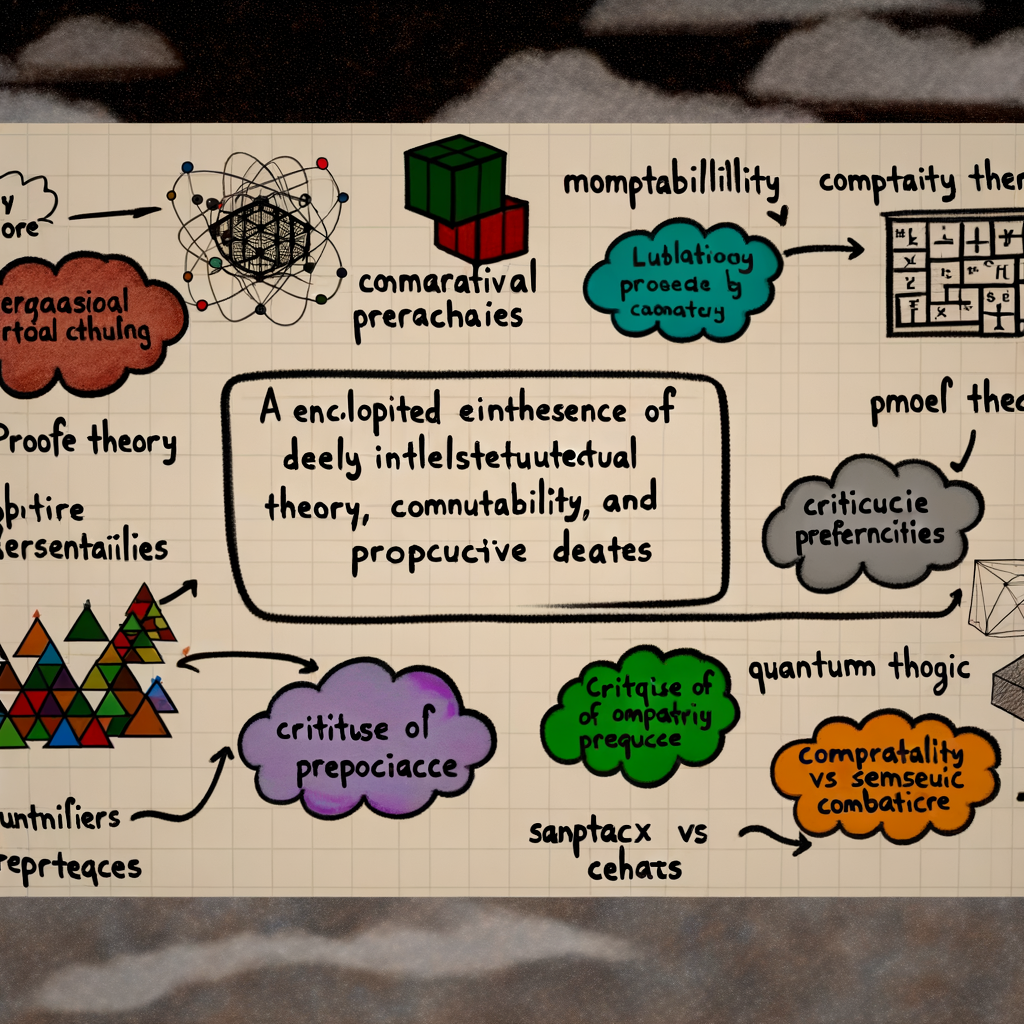 # You loved the idea of logic in college. You also loved late-night metaphysics and terrible indie films. That’s fine — they can coexist.
You remember the warm glow of a completed proof, the crispness of a definition that actually snapped closed before 2 a.m. Also: memes, cranky filmmakers, and the occasional existential detour. None of those pleasures are forbidden by logic; some of them simply aren’t logic. This is a short, practical map for people who survived college, want their ideas to behave like math sometimes, and don’t need another New-Age metaphor to justify sloppy thinking.
## What logic studies — in plain(ish) terms
At bottom, logic studies relations between claims: what follows from what, what supports what, when an argument is valid. That ranges from the austere symbolic toolkit (propositional and predicate logic, modal logics, proof theory) to messier philosophical questions about meaning, reference, and paradox.
Useful mental categories: quantifiers (for all / there exists), syntactic versus semantic validity (does a string of symbols follow the rules vs. does it faithfully represent meanings in structures?), and domain-specific calculi (modal logic for possibility/knowledge, temporal logic for time, quantum logic for measurement oddities).
A filmmaker saying “I hate making films, but I hate not making films even more” raises a classic confusion: is she declaring hatred of everything, or placing two options on a scale? We unpack that with quantifiers and comparative predicates: universal claims assert total coverage; comparative claims just rank a few items. The filmmaker’s sentence is the latter. She’s not indicting existence.
## What logic cheerfully ignores
Some things wear the trappings of logic but don’t belong to the club:
– Party puzzles that delight but lack a formal structure worth analyzing.
– Electrical gate engineering — unless you recast the problem in formal language and care about the algebraic properties.
– Statistical inference (Bayes vs frequentist) — that’s a different toolbox; it answers different kinds of questions.
– Free-floating metaphysical pronouncements dressed up in logical words to sound deep.
Translation: before you pontificate, ask if you’re talking about form (how arguments hang together) or content wearing a logic costume. If it’s content, find the right department — there’s no shame in outsourcing.
## Proof by resonance: neat metaphor, dangerous habit
Someone once proposed “proof by resonance”: if an object fits every definitional slot, behaves consistently across contexts, and feels right, it’s proven. Charming. Also risky.
Good proofs are multi-pronged: syntactic checks (are the inference steps legal?), semantic checks (do models validate the claims?), structural checks (is there an isomorphism, characterization, or normal form?), and stability checks (does the property persist under reasonable transformations?). “Resonance” bundles these into a warm mnemonic, but it can sneak in circularity: things might resonate because your contexts all share hidden assumptions.
A concept that resonates still needs counterexamples handled rigorously. A beautiful story isn’t a substitute for a countermodel.
## Cross-sections: how different parts of math shape the map
– Proof theory and automated reasoning: practical and philosophical. We want machine-checkable proofs that humans can understand. That drives work on normalization, proof compression, and interactive proof assistants.
– Model theory: basically the study of structures that make sentences true. It’s where syntax meets geometry — classification theory, stability, and definability show how algebraic shapes encode semantic possibilities.
– Category theory: the abstract glue. It teaches us to see patterns of transformation — morphisms and universal properties — that unify algebra, topology, and logic. Think less cathedral, more Swiss Army knife for structural thinking.
– Modal/temporal logics: indispensable when time, knowledge, or obligation matter. Computer science, AI, and epistemology borrow these heavily.
– Computability and complexity: the sobering limits. Some questions are decidable, some aren’t; some are feasibly solvable, most are not. It’s the field that reminds you that clever metaphors don’t bypass hardness.
– Quantum logic: a domain-specific algebra. Superposition and measurement change how propositions combine. It doesn’t overthrow classical logic for daily life; it’s a different calculus for a different ontology.
– Linguistics & cognitive science interfaces: these remind us that human reasoning is noisy, context-sensitive, and often non-classical. Formal systems are idealizations — extremely useful ones — but we should be careful mapping them straight onto messy minds.
## Two sides of useful disputes
People argue passionately about whether logic is normative or descriptive: should logic prescribe how we ought to reason, or describe the structure of good reasoning? Both sides have weight. Normative claims explain why certain inferential rules are binding; descriptive claims explain how actual thinkers behave and why heuristics exist.
Another live dispute: is category theory a unifying language or a layer of abstraction that hides concrete phenomena? Fans love its explanatory power; critics sometimes want more tangible calculations. Both are right: category theory is spectacular at revealing patterns, but you still need hands-on tools for computations.
## Quick practical checklist for tidy thinking
– Ask: are you making a universal claim or a comparative one? Spell it out.
– If you like a metaphor (resonance, elegance, naturalness), translate it into formal checks: syntactic, semantic, structural, stability.
– Use domain-specific logics when the ontology demands it (knowledge, time, measurement). Don’t overgeneralize.
– Learn a bit of computability and complexity; knowing limits prevents a lot of dumb bets.
– When in doubt, try to build a countermodel. If none appears, articulate why your contexts are restricted.
## Parting thought (and a question)
Logic isn’t a cathedral of eternal pronouncements — it’s a toolkit. Use universal quantifiers for coverage, comparative language for preferences, syntactic checks for proofs, and domain-specialized systems when your world refuses to be classical. And yes, metaphors like “resonance” are great at dinner parties, but they don’t absolve you from defining terms and checking counterexamples. Don’t be afraid to be charmed, just be prepared to be wrong.
So: when you next catch yourself saying something that feels profound because it ‘‘resonates,’’ which of the four checks (syntactic, semantic, structural, stability) will you run first — and why?
