Little Theorems, Big Feelings: How to Collect, Complain, and Canonicalize Your Way Through Category Theory
 If you ever graduated during the mixtape-and-dial-up era, you remember that little, gleeful discovery: a trick you did not know you could do, a tweak that saved you an hour. Category theory is the grown-up, far more elegant version of that thrill. Instead of a tape, your reward is an elegant commutative square; instead of applause, you get two polite grad students and a confused preprint. Celebrate those tiny wins: competence is built one defensible diagram at a time.
Little victories: publicize your ‘I finally get it’ moments
There is a special, slightly guilty joy in discovering a fact textbooks treat as routine. Maybe a universal property clicked when you drew the right diagram. Maybe you rewrote a definition so it fit your brain like a glove. Don’t hoard this stuff. Share it. Post it. Put it in a forum where strangers will nod and someone will correct the sign of a morphism. Those micro-outputs create an archival breadcrumb trail that helps the next bewildered person.
Assemble your personal canon: long reads worth shelving
Short tutorials triage immediate pain; long-form companions cultivate taste. Keep a curated bookshelf: one gentle guided tour, one rigorous textbook, and one masochistic monograph that will humble you on purpose. Mix classics with a focused thesis and an interdisciplinary essay to see categorical thinking leak into CS or logic.
Ultrafilters and compact Hausdorff spaces: ask the concrete question
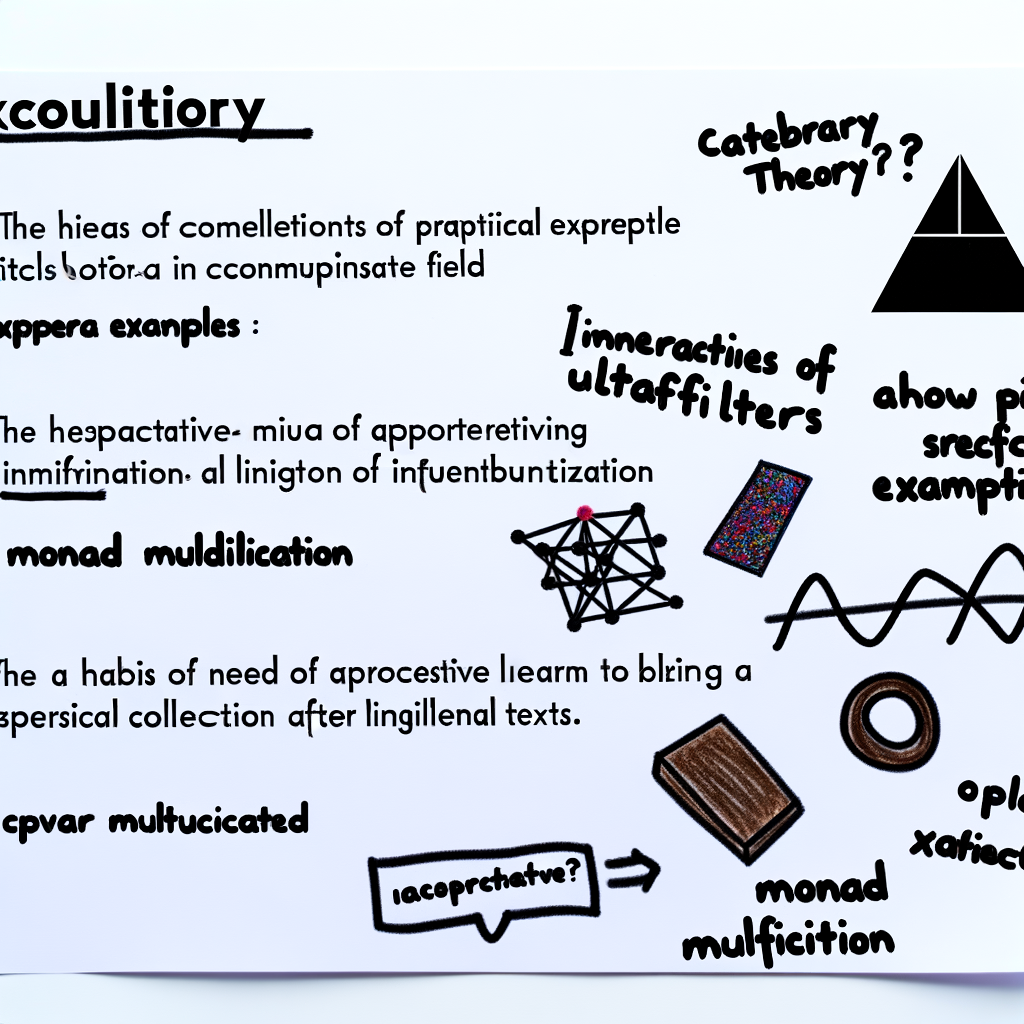
Here is a nerdy crossroads: given a compact Hausdorff space, what are its ultrafilters? Ultrafilters sit at the heart of the Stone–Cech compactification and, categorically, as algebras for the ultrafilter monad. If you want to mean anything with that equivalence, start with concrete examples: beta-N, profinite spaces, and other familiar beasts. Tracing how ultrafilters concentrate, lift, or collapse in examples is the fun part.
Ologs: applied category theory hampered by sketchy tooling
For applied category work—schema design, systems architecture, ontology modeling—you’ve probably met ologs. They are appealing in spirit: labeled boxes and arrows meant to encode meaning, not just types. The friction is tooling. Generic diagram apps export SVG nicely but rarely validate instances, products, coproducts, spans, or universal properties. The pragmatic fix: build the tooling you wish existed, or embrace a picture-plus-spreadsheet workflow.
Mu as a projection: when monads feel like linear algebra
A student once observed that after linearizing a monad (pushing your category into vector spaces), the monad multiplication mu begins to look like a projection. Certain composites become idempotent and split, so mu corresponds to projecting onto an image subspace. In the Karoubi envelope, that intuition formalizes. This links abstract monadic flattening to something tactile and often simplifies proofs.
Tradeoffs
Category theory oscillates between aesthetic purity and brute utility. It gives compact, expressive frameworks, but that same abstraction can exclude or obscure. Be explicit about goals: for engineering ergonomics favor concrete instances and tooling; for conceptual clarity accept a slower burn and patient theorem chasing.
Quick practical checklist
– Celebrate and record small insights; they compound.
– Keep one gentle intro, one rigorous textbook, one specialist monograph.
– Ground monstrous constructions in examples before chasing generalities.
– If you use ologs professionally, build light validation tools or embrace a multi-tool workflow.
– Hunt for linear-algebraic shadows; they often simplify proofs.
Takeaway and a question
Category theory is equal parts aesthetic pleasure and practical utility. Keep learning, keep sharing, and when your diagrams finally commute, take a photo and post it. Future you will thank past you for the evidence of progress. When a high-level categorical equivalence has a clean concrete description (think ultrafilter-algebras ≅ compact Hausdorff), what is the right balance between celebrating unity and insisting on the messiness of explicit examples? Is abstraction the map or the territory—or both?
