The Categorical Imperative: Stop Treating Math Like a Meme (and Post Like a Grown-Up)
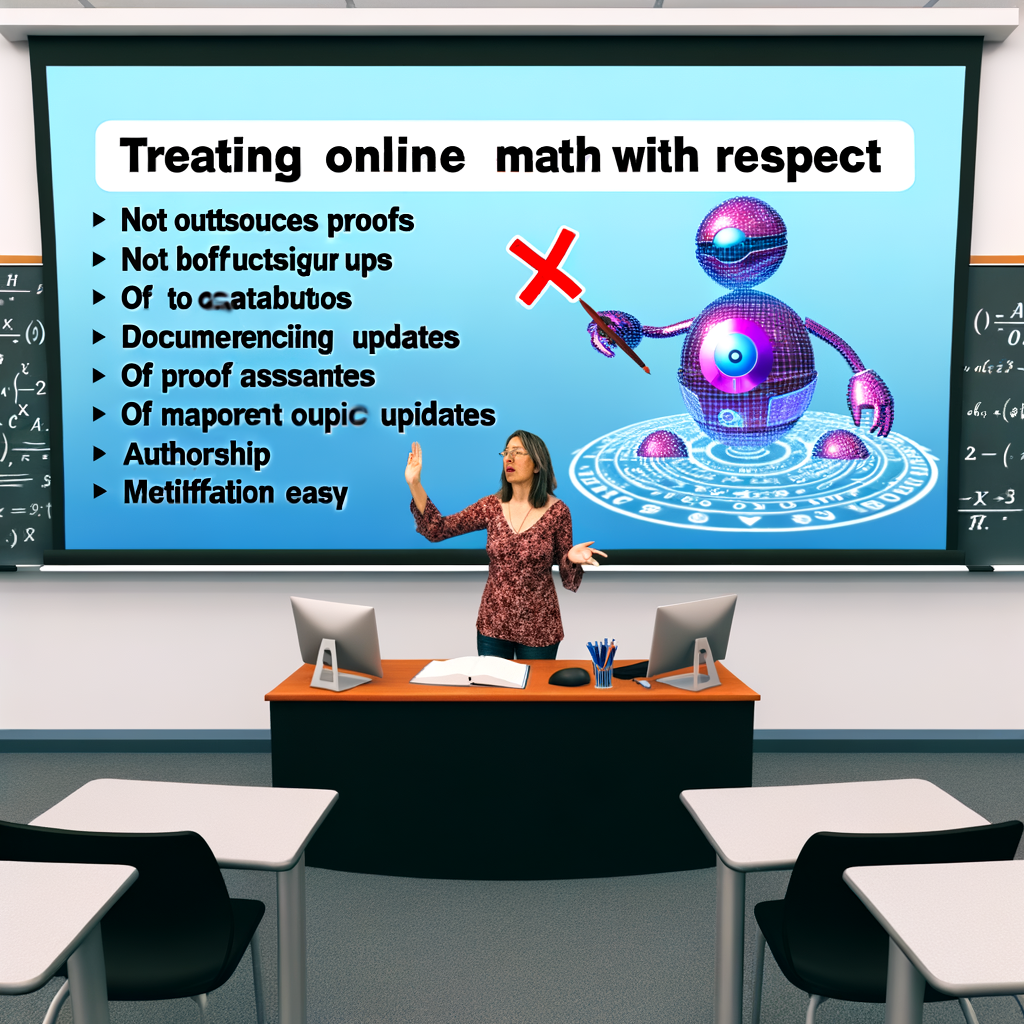 # The Categorical Imperative: Stop Treating Math Like a Meme (and Post Like a Grown-Up)
If the internet has taught us anything, it’s that people will gleefully build castles out of numbers, add a few banners, and then ask strangers to clap. Somewhere between heroic “huge numbers” and earnest Fourier-to-binary hacks there’s a carnival of brilliance and confusion. Toss in folks letting ChatGPT do the heavy lifting, and you’ve got wrong answers that read like poetry.
This is the short, slightly bitchy course in doing math online like an adult: don’t outsource your reasoning, be clear about where ideas come from, and for heaven’s sake, tell people what changed.
## Don’t outsource your proofs to a chatbot
Language models are great at sounding smart in cocktail-party ways. They are not checks on mathematical truth. An LLM will happily invent algebraic steps or hallucinate theorems with the confidence of a tenured professor who skipped peer review. That’s fine for a first-pass explanation or drafting copy — horrible for claiming a new result.
If you need computational muscle, bring the right tools: WolframAlpha and SageMath for heavy symbolic/numeric work; Lean, Coq, or Isabelle for formal verification. Automated theorem provers and proof assistants make different promises: CAS tools help compute and explore; proof assistants let you encode axioms and get mechanically verified deduction. Use the right one for the job, and always verify important steps by hand or machine. Treat any LLM output as a draft that you must check — “it felt right” is not peer review.
## Be the author, not the courier
There’s a weird middleman problem online: person A posts person B’s idea and disappears. Conversation stalls because the intermediary can’t authoritatively field objections. In category-theoretic language: arrows without clear domains and codomains cause confusion. If you’re sharing someone else’s work, get them to post or at least state authorship clearly, include consent, and attribute properly.
Authorship isn’t vanity—it’s accountability. When the originator engages, the community can iterate productively; when they ghost, you get a bureaucratic dead-end of speculation and secondhand mistakes.
## Update responsibly: changelogs are not optional
Mathematics is iterative. A 40-page rewrite with one corrected sign and zero explanation is a trap. Label edits with [UPDATE], put a concise changelog at the top, and say what changed, why, and where. Think of it like commit messages in a git repo: useful to future you and to everyone building on your work.
A short changelog reduces duplicate critique, preserves thread history, and prevents yesterday’s criticisms from being recycled as if nothing happened.
## How to ask for feedback without sounding like a mad scientist
Drop the 12-page PDF with no map, and you’ll get fewer useful replies. Make it easy to test:
– One-sentence abstract that states the claim plainly.
– Minimal working examples and relevant edge cases.
– Runnable code snippets or a link to a public repo/notebook.
– Specific questions: correctness, complexity, special cases, counterexamples.
Scaffold the conversation. People will help when the cost of entry is low.
## Big numbers, bigger disclaimers
If you invent a “Hyper Factorial Level” and build six canonical laws around it, I will be delighted and suspicious in roughly equal measure. Novel notation and grand constructions are part of math’s romance — but clarity wins. Define notation clearly, show levels 1–3 worked out, and explain why anyone should care beyond the novelty. Don’t create rules that make verification impossible; if your notation forces people to squint harder than to read a differential geometry textbook, you’ve lost the audience.
There’s a tension here: mathematical creativity begs for expressive notation, while communal verification demands simplicity. Remember: a new symbol is only useful if other people can manipulate it.
## Verification isn’t optional — it’s courteous
If you want your idea to survive critique, make it reproducible. Deposit code and papers where people can access them (Zenodo, arXiv, GitHub). Include tests, expected outputs, and a short guide to run them. When you do this, responses shift from “That looks suspect” to constructive counters or optimizations.
And when someone points out an error: update, explain, and move on. Math isn’t a duel; it’s a conversation. Publicly acknowledging a fix raises trust, not shame.
## Cross-disciplinary nuance: proofs, experiments, and everything between
Different corners of math have different norms. In pure logic or algebra, a proof is binary: correct or not. In numerical analysis, statistical inference, or experimental mathematics, evidence and heuristics are part of discovery. Model theorists will happily debate axioms; applied people will run millions of simulations and call that progress.
Both modes matter. Exploratory computation can suggest conjectures; formal proofs secure them. Online discourse often collapses the distinction: a computational experiment gets treated like a proof, or an elegant heuristic is demanded to be fully formalized immediately. The mature stance is to label the mode: “This is experimental evidence” or “This is a conjectured theorem with a sketch proof.” Clarity about epistemic status is kind to readers and fair to your work.
## Final note: numbers are fun, but keep them honest
The internet mixes real discovery, showmanship, and the occasional fever dream. That cocktail is glorious, but if you want your ideas to live past a few punchy comments, ship responsibly: be the author, verify with appropriate tools, annotate updates, and make it easy for others to engage.
And because I enjoy a good rhetorical nudge: treat your math posts like open-source projects. Make them reproducible, document changes, and make collaboration frictionless. Your HFLs, Fourier-binary hashes, and audacious conjectures might actually survive the comments — and maybe even improve.
So tell me, if you could change one small habit of the internet math community today, what would it be? Would you demand proof assistants on all claims, force changelogs, or just make people post runnable code with every big number? I’m curious — and slightly hopeful.
