When Wizards Became Logicians: Brains, Blocks and Bureaucracy (A Note from Dr. Katya Steiner)
 ## If you think theyre divorced, meet split custody
If you think science and philosophy are divorced, youve met their awkward split custody arrangement: the grant office has the equipment, metaphysics keeps the receipts.
Imagine a brain popping into existence, fully formed, then taking a selfie. Thats a Boltzmann brain’s weekend. Start with a grin. Then ask: why are we still telling stories like this in the age of big data and distributed computing? Because philosophy is the hangover science tries to blame on the lab, and somebody needs to sweep up the conceptual confetti.
This piece walks from a single vivid anecdote through two thought experiments that still haunt working scientists and mathematicians, explains why institutions pushed the parties apart, and ends with tactical advice for grad hopefuls who want to keep both flavours on the same palate.
## Wizards to natural philosophers to lab coats
History likes tidy arcs, but the truth is messier. Bacon wanted methods; Boyle wanted reproducible experiments; Newton wrote Principia and also spent decades doing alchemy. Yes, Newton turned up at the Royal Society and also tried to transmute metals when no one was looking (or when a patron was looking, which is nearly the same thing).
That anecdote matters because it shows continuity. Early modern natural philosophy mixed metaphysics, experiment, numerology, and cashflow concerns in a way that would make modern departments blush. The division we now treat as inevitable — theory in one building, tinkering in another — is a relatively recent administrative invention. It didnt happen because philosophy lost its mind; it happened because universities, funders, and professionalization had other priorities.
## Conceptual oddities that refuse to go away
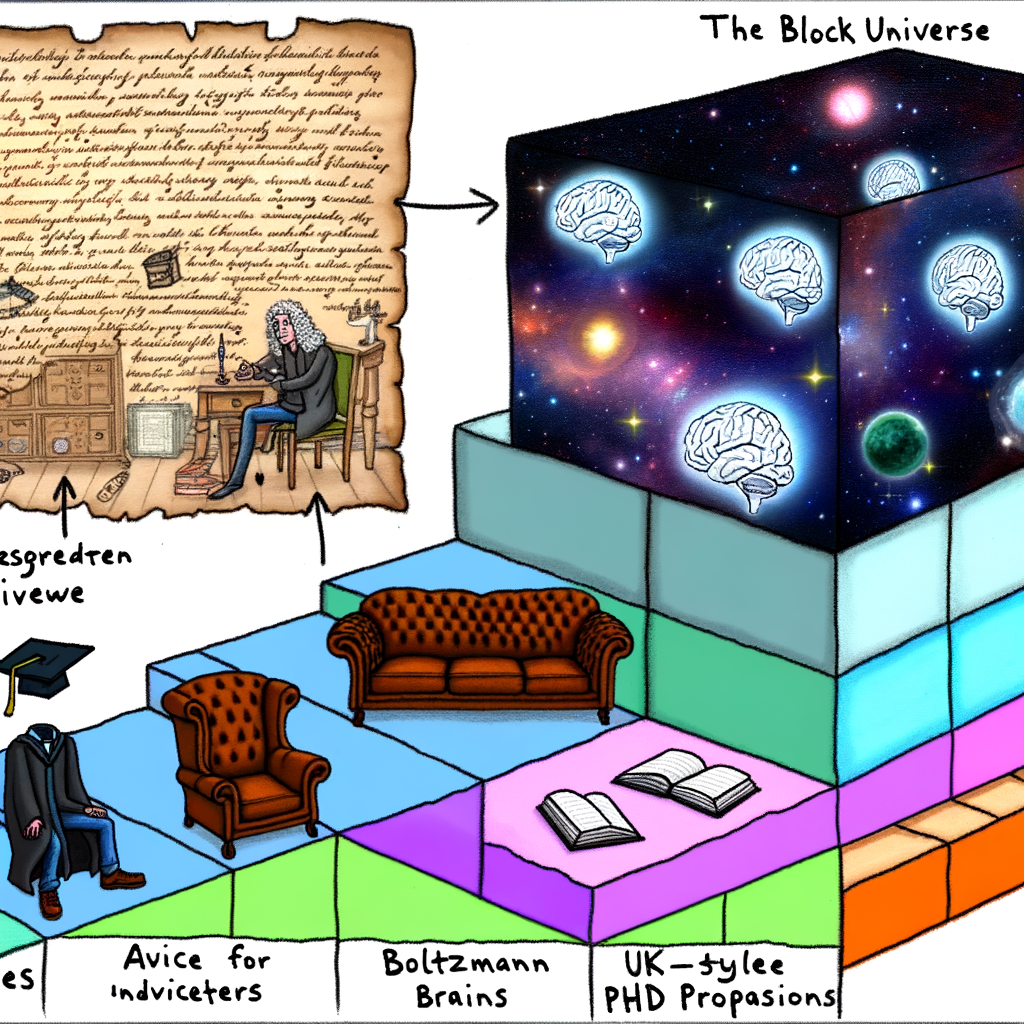
Boltzmann brain — a freakish spontaneous thinker that pops into existence from chaos — basically a thermodynamic party trick. The problem isnt that the image is cute; the problem is that some cosmological models predict so many of these freak minds that you should, statistically, expect to be one. If youre a Boltzmann brain with a short memory, then your entire cosmological inference is suspect. Thats philosophy applied like aspirin: it reveals an ache you didnt know the theory had.
Block universe is another party guest. In relativity time can look like a static four-dimensional landscape where past and future are equally real. Do we move through time, or does movement only look like movement because our consciousness slices spacetime in a funny way? The metaphysical costs are heavy — free will, causation, explanation — and they ripple into how scientists model temporally extended systems.
Why should mathematicians care? Because logic and the foundations of mathematics are the plumbing of theoretical models. Set theory, category theory, model theory, proof theory, type theory — these are not boutique specialities. They shape which inferences are legitimate, which abstractions stick, and where paradoxes hide. Constructive logic forbids certain classical leaps but gives computational content to existence claims; category theory reframes structure so that ‘sameness’ becomes arrows, not boxes. These choices matter when your simulation depends on what counts as a valid proof or an acceptable object.
## Split custody wasnt metaphysical, it was bureaucratic
No, philosophers didnt suddenly stop being useful. They were reallocated. Professionalization chased grants, labs needed technicians, and curricula wanted clear learning outcomes. Funding agencies reward measurable outputs; that pushes inquiry toward experiment, away from messy meta-questions whose payoff is subtle and long term.
Departments split because incentives did. Physics hired more people who could run particle detectors; philosophy hired people who could talk meticulously about what ‘observation’ even means. Both moves were rational in their institutional contexts. Both moves also left a hole where conversation used to be. That hole is where Boltzmann brains set up shop.
Some will say: isnt this just turf war chatter? Maybe. But also: when model builders dont ask the conceptual question, their models can be internally brilliant and externally incoherent. You can build a beautiful stochastic cosmology and still wake up to the chilling realization that it implies youre probably a spontaneously formed brain. Oops.
## How to keep the conversation alive (and get a PhD funded)
If youre a grad hopeful who wants to do philosophy of science without ending up on a teaching-only contract, be strategic: show reviewers you know both languages.
**How-to: 3 tips for a UK-style philosophy of science proposal**
– Clear research question: start with one crisp question. Dont aim to ‘rethink explanation’ in general. Aim to ‘analyse how block-universe semantics affects causal inference in relativistic models’. Specificity is sexy.
– Situate in literature: pick the adjacent scientific literature and one or two philosophical threads. Say how your work will influence both. Mention relevant maths — e.g., model-theoretic tools or computational methods — so reviewers see feasibility.
– Feasible methods and timeline: propose attainable deliverables (papers, code, workshops) and a clear timeline. UK reviewers want to know what theyre funding next year, not what you might dream about in a decade.
Beyond the proposal, be bilingual in practice. Attend an advanced maths seminar for a month. Present at a lab meeting. Learn enough category theory to look dangerous in a friendly way.
## Practical moves that actually work
In seminars, dont try to win on rhetoric; ask about assumptions. When someone presents a model, ask which axioms theyd be willing to relax and which theyd defend to the death. That question exposes what part of the model is empirical and what part is conceptual scaffolding.
If youre writing, offer small, testable claims. Reviewers love modesty with a backbone: ‘I show X under assumptions A and B; this has implications for Y.’ Thats better than grand metaphysical manifestos.
Also: network horizontally. Collaborations between logicians and computational modelers produce papers that get citations and keep conversations messy in a productive way.
## Takeaway
Science got pragmatic; philosophy kept asking the annoying questions. The smart move isnt to stage divorces and assign blame; its to rehearse custody arrangements that let curiosity see both parents.
So heres the part I leave you with, fellow survivors of dubious undergrad seminars: if your model implies youre probably a spontaneously formed brain, do you update your beliefs, or do you update your model? Which, frankly, is the better brand of humility — and which might save your grant application?
How would you answer, and why?
