The Categorical Imperative: Don’t Make Math Pay Rent — A Sardonic Survival Guide for New Grads (Dr. Katya Steiner)
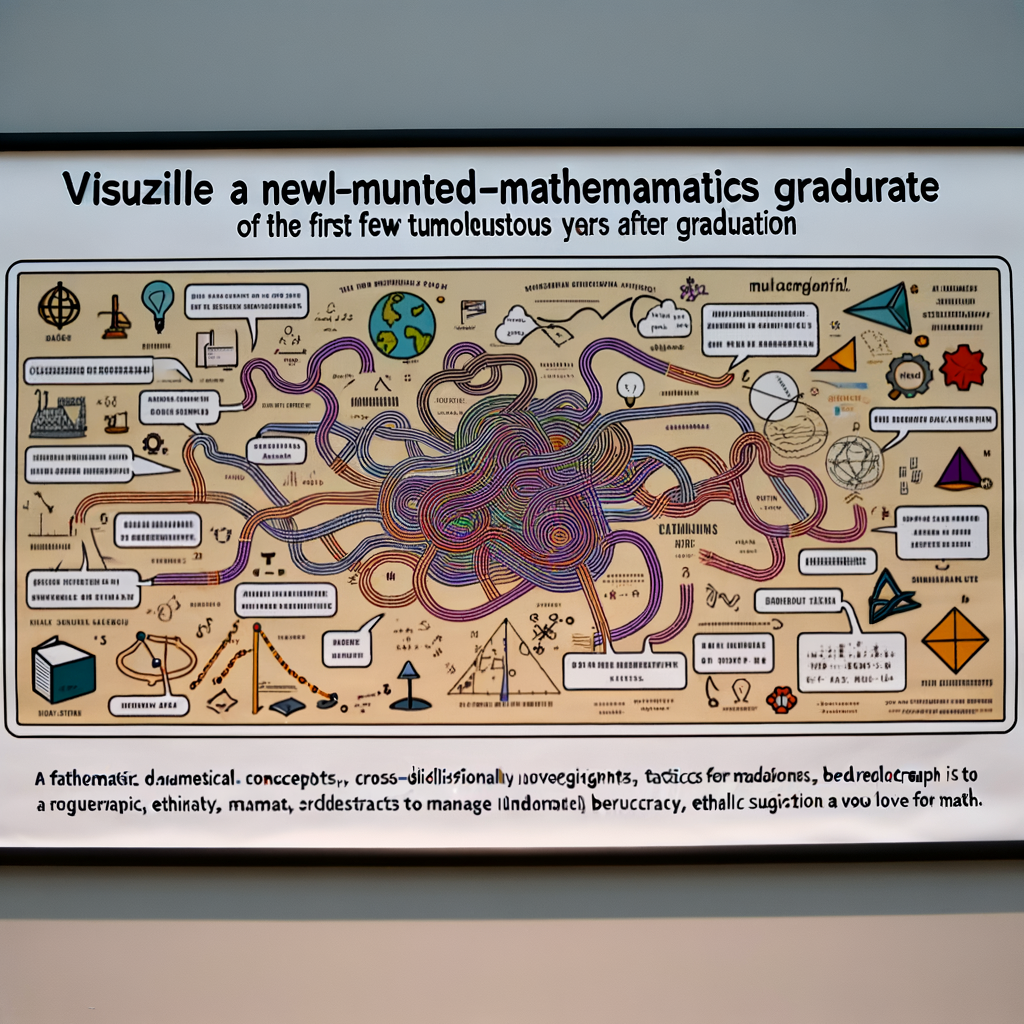 # Don’t Make Math Pay Rent: A Sardonic Survival Guide for New Grads
You’ve graduated. Your diploma looks fancy and the student loans look subsidized by sudden dread. People will ask you whether math is “useful,” as if usefulness is the only virtue and as if your taste in theorems can be monetized the same week you hand in your final grade report. Here’s the thing: math is both beloved and chronically misunderstood. That’s not a bug; it’s an ecosystem feature.
Think of this as the categorical imperative for young mathematicians — an ethical and pragmatic guideline: treat your math as a thing you cherish, and also as something you know how to translate when someone hands you a hiring manager, a grant officer, or a visa officer who only speaks forms.
## Where to ask the right kind of question (and why phrasing matters)
Want better answers? Ask better questions. This is true whether you’re digging into the subtleties of adjoint functors or trying to understand why your MCMC sampler keeps getting stuck.
– Give one-sentence background: “graduated in math; comfortable with linear algebra and measure theory.” It’s not bragging — it’s signal.
– Say your goal. Are you prepping for qualifying exams, pivoting to data science, or asking why homology groups feel like algebraic mood rings? Context drives the quality of help.
– Show what you tried. A sketch of your failed attempt is the best icebreaker.
Concrete example: instead of dumping an entire homework set, ask: “I understand the definition of a left Kan extension but not how it differs intuitively from an adjoint; can someone give a high-level picture and a simple example?” That attracts thoughtful replies, not performative grading.
## Career moves that don’t require moral compromise
Grad school or industry? The answer is situational and, yes, boring: if you love open-ended questions and can eat uncertainty for breakfast, grad school is good. If rent and a semblance of retirement savings matter, go industry.
Crucial translation work: reframe abstraction as a skill set employers want. Don’t say “I like category theory” — say “I’ve built abstractions that made complex systems modular,” and have a repository to prove it. Sample portfolio items:
– A GitHub repo implementing spectral methods for PDEs with tests and a short explainer.
– A blog post mapping representation theory concepts to real-world symmetry detection in images.
– A reproducible analysis showing bias-variance trade-offs in a dataset, complete with code.
Employers and committees prefer evidence over rhetoric. Show, don’t sermonize.
## Books, starting points, and the gentle tyranny of choices
Pick books that balance rigor and intuition. If you want a tidy path:
– For analysis and probability: Stein & Shakarchi or Folland for the brave.
– For algebra and structure: Dummit & Foote for algebraic plumbing; Rotman if you like commentary.
– For category-theory curiosity: Riehl for intuition, Mac Lane if you like classical bones.
– For combinatorics and discrete math that employers recognize: West, Miklós Bóna, or even practical algorithm texts.
If you’re aiming for research, read deep. If you’re aiming for industry, code with math. If you’re doing both, carry two notebooks — one for proofs, one for APIs.
## When institutions act like Rube Goldberg machines
I’ve seen programs die because a compliance checkbox was missing. Fingerprints, visas, and other administrative gremlins will eat good ideas alive.
Don’t rely on a single program or sponsor. Plan fallback funding. Partner with smaller organizations that move fast. Document everything. Cultivate at least one person in authority who can bypass the machine when it chokes. Systems are designed to be boring and slow; your task is to be boringly prepared.
## Why “making math relevant” can feel insulting (and how to do it better)
Telling pure math to “pay rent” is like asking poets to invoice metaphors. Math has intrinsic value. Its beauty is not a commodity. That said, if we can’t show how abstraction translates into impact, we lose the room and the grants.
Balance is the trick. Keep free space for pure thinking — seminars where you chase a proof because it’s elegant, not because it deploys in industry tomorrow. But also teach people how to tell two stories about their work:
1. The love story: why the math is compelling.
2. The résumé story: what systems you can improve with that love.
Both are true. Both matter.
## Cross-sections: logic, disciplines, and why each one matters
– Model theory and data: thinking about structures and definability helps when designing schemas or feature representations. It’s not just pigeonholing; it’s conceptual clarity.
– Topology and shape analysis: persistent homology sounds niche until you realize people want to quantify shape in materials science, neuroscience, and data analysis.
– Category theory: yes, it’s abstract. But its language unifies APIs, modularity, and composability — useful metaphors for software architecture.
– Probability and statistics: this is the lingua franca for industry. Know how to lie with statistics and how to stop yourself from doing it.
– Complexity theory: understanding hardness is a competitive edge when evaluating what can be automated and what needs human judgment.
Seeing the conversation between these areas — how a categorical lens can inform a statistical pipeline, or how proof techniques illuminate algorithmic correctness — is where real creativity lives.
## Global talent, sponsorship gaps, and small acts that matter
A prodigy blocked by a visa or a missing sponsor is a moral problem and a loss of potential. If you can mentor, hire remotely, or donate an entry fee, do it. Advocate to your institutions to accept alternative documents. Crowd-funded scholarships and remote mentorship are small interventions with outsized effects.
## Quick tactical checklist
– Ask conceptual questions clearly, with constraints.
– Build evidence: repos, write-ups, and reproducible projects.
– Choose grad school for curiosity; industry for stability — but both require demonstrable work.
– Diversify program funding and hosts to survive bureaucracy.
– Teach without apologizing for math’s beauty; teach translation too.
– Mentor globally; pick one person to help this year.
## Final thoughts (and a question to keep you up in a good way)
Math shouldn’t have to pay rent to be worth something, but you will be judged by signals: work that’s visible, projects that run, and the people who can vouch for you. Preserve space for the unsellable joy of proof while learning to translate it into signals a funder, employer, or bureaucrat can read.
So here’s my parting question, because I like to leave things open: how will you protect the part of your mathematical life that refuses to be transformed into a product, while still building the kinds of visible, reproducible work that let you eat and keep thinking?
