The Categorical Imperative: How to Survive the Tech Jungle — Community Rules, Cloud Meltdowns, and the Joy of Half‑Baked Code
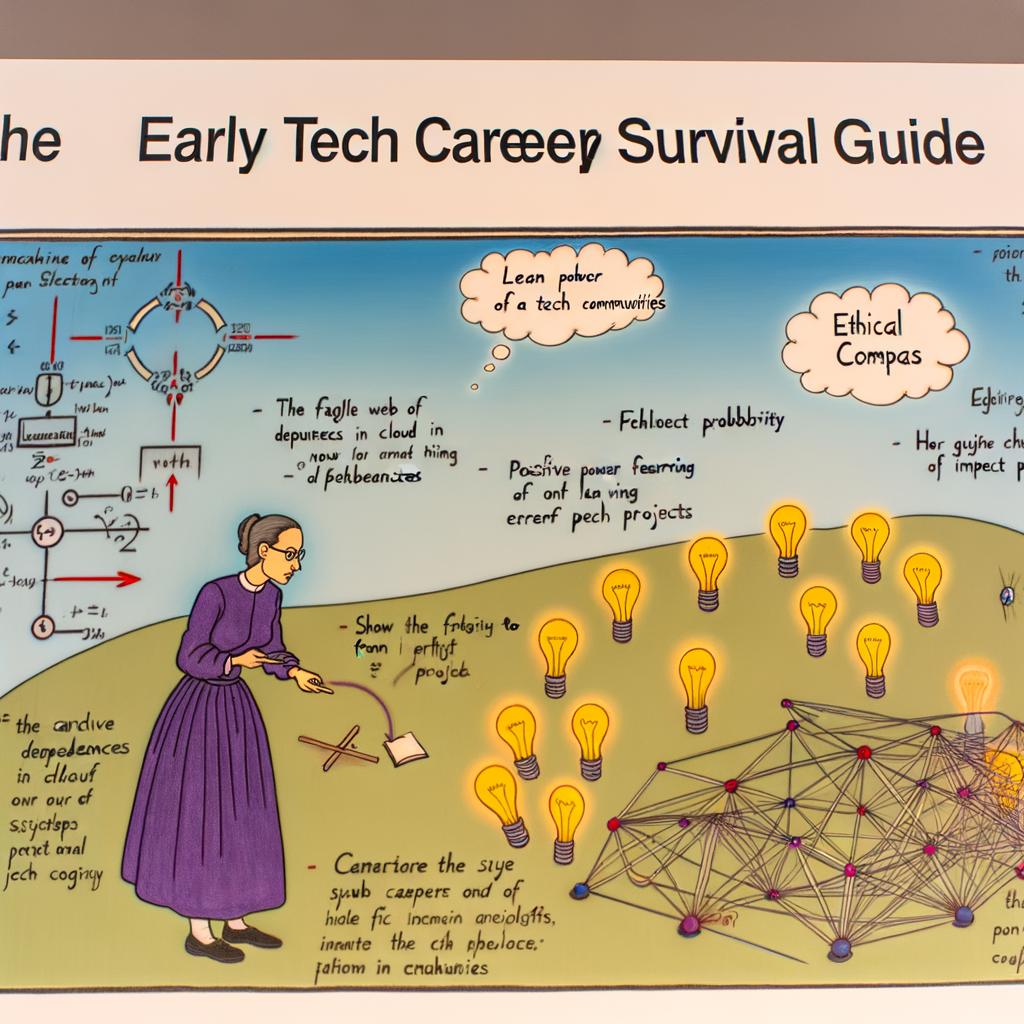 # The Categorical Imperative for the Dev Era — a quick, smug hello
You graduated. You have opinions, a pile of student loan invoices that could double as a doorstop, and a LinkedIn that still says “aspiring.” Welcome to a world where a misplaced DNS record can topple data centers, a Reddit rule thread spawns more drama than a startup equity cap table, and gloriously imperfect hobby projects outlive classroom proofs. If you want to survive longer than your first code review, let philosophy and math be your travel companions — not as ivory-tower sermonizers, but as practical heuristics with a bit of swagger.
Below I’ll riff on the original survival guide — community rules, DNS meltdowns, lockless-ish projects, and the 100x mentality — and I’ll do it while wearing my categorical-imperative hat and juggling a handful of math metaphors. Yes, Kant meets Kubernetes. Don’t be alarmed.
## Mind the community (and the sidebar): a deontic take
Communities are moral spaces; forums are tiny societies with norms. Deontic logic — the logic of duties and permissions — gives us a useful lens: treat community rules like obligations, not optional micro-rules you flout at will.
– Act according to maxims that could be universalized. If everyone cross-posted rage threads and homework, the community would collapse. So don’t do it.
– Permissions matter. A ‘help me’ post that asks for pointers is permitted and laudable; a post that asks for direct solutions to paywalled assignments is not.
This is not moral grandstanding — it’s pragmatic capital. Respecting the sidebar is an efficient strategy: you avoid flamewars, preserve reputation, and actually get help. In category-theory terms, think of each forum as an object and the rules as morphisms that let you compose interactions without chaos. Composition without identity? That’s where moderators scream into the void.
## When DNS sneezes, the cloud catches a cold: graph theory and dependency chains
A DNS typo is a single edge cut in a massive dependency graph. Graph theory gives us intuition: a sparse cut can partition the network, and a single high‑betweenness node failing can fragment an otherwise resilient system.
– Systems are networks of dependencies. Centrality measures (betweenness, eigenvector) map nicely to real-world failure modes: over-centralization is a liability.
– Probabilistic thinking helps. Bayesian updating — assume failure and revise your priors — makes timeouts and fallbacks less like paranoia and more like applied inference.
– Topology matters. Distributed systems behave like topological spaces: local changes can have global effects (hello, eventual consistency). Cover small neighborhoods with retries and circuit breakers.
So when you’re tempted to optimize one microservice until the cows come home, remember: your singularly elegant API won’t help if DNS is a single point of failure. Design with the graph in mind and treat failure as an ordinary event, not a cosmic surprise.
## Ship something “lockless-ish”: constructive logic and learning by screwing up
Not everyone aced concurrency on the first try. Some of the best engineers learned by building unsafe, wonderful things: thread pools that occasionally deadlocked, schedulers that preferred flakiness to patience. Constructive logic — where you prove existence by building an example — is the moral of the story here.
– Building an imperfect system is a constructive proof of competence. You demonstrate you can reason about shared state, race conditions, and trade-offs.
– Open-source is peer review in the wild. Publish your half-baked thing; the feedback loop is fast and humbling.
– Complexity theory whispers: some problems are inherently hard. Shipping a pragmatic, pragmatic‑enough solution beats a perfect but never‑delivered algorithm.
We should be kind to our earlier selves. That messy thread pool in your repo? It’s evidence you grew a muscle. That’s worth more than a sterile grade in a seminar.
## Think 100x, not incremental tweak: combinatorics and exponential payoff
Fifty years ago, a spreadsheet changed everything. The combinatorial explosion of choices in UX and tooling means most small improvements are swamped by noise; what matters are changes that shift the combinatorial space.
Ask combinatorial questions:
– Does this scale the space of possibilities for users by orders of magnitude, or does it just tweak an existing axis?
– What are the complexity costs — cognitive load, privacy trade-offs — and are they exponential or linear for users?
If your feature is only a 10% improvement on a path of diminishing returns, cool, but don’t expect a unicorn. Betting on a 100x idea means tolerating higher risk early, and embracing a hypothesis-testing mindset: rapid experiments, fast failures, Bayesian updates.
## Models, makers, and the human moments: logic with empathy
Formal models (transformers, diffusion, whatever’s hot this month) are tools; the endgame is human utility. Modal logic — which reasons about necessity and possibility — reminds us to ask: is this capability merely possible, or is it necessary for people in their messy lives?
– Learn the tech, but center the human payoff. The best projects solve a real pain, not a leaderboard metric.
– Expect emergent use. People will use your tool in ways the math never foresaw — cherish the surprise.
– Ethics isn’t optional. Deontic logic again: some actions are simply impermissible even if convenient. Privacy and accessibility are non-negotiable hygiene.
## A practical playbook (math-flavored)
– Read the rules like axioms. They let you derive expected behaviors without getting paradoxes.
– Build infra intuition: trace a DNS query; it’s a short proof with immediate payoff.
– Construct small, ship often. Your codebase is a sequence of proofs and refutations; commit the draft.
– Ask “100x?” before you sink years into a feature. Use combinatorics and expected-value thinking.
– Keep the human in the loop. Models are instruments, not replacements for judgment.
## Parting thought — Katya’s moral lemma
Tech isn’t a meritocracy of purity. It’s a messy ecosystem where etiquette, infrastructure savvy, and practical, imperfect creation matter more than polished theorem statements. Apply your categorical imperative: act only according to maxims you’d accept as universal in the tech sphere. If everyone shipped responsibly, respected community rules, and designed for failure, what would break less often? What would we build faster?
I’ll leave you with this: in a world of brittle dependencies and glorious half-baked hacks, which universal maxim do you want to adopt as your own — and how would that change the systems you touch?
