The Categorical Imperative: Sexy Pictures of Messy Fluids and What Math Actually Does About It
 # The Categorical Imperative: Sexy Pictures of Messy Fluids and What Math Actually Does About It
We were taught to worship the elegant, reductive ideal: a vortex with speed ~1/r, a perfect solution you could parade across a chalkboard. Then you go to the lab and find a squidgy, viscous thing that refuses to respect your asymptote. Welcome to the world where math gets its hands dirty and the pictures are unapologetically sexy.
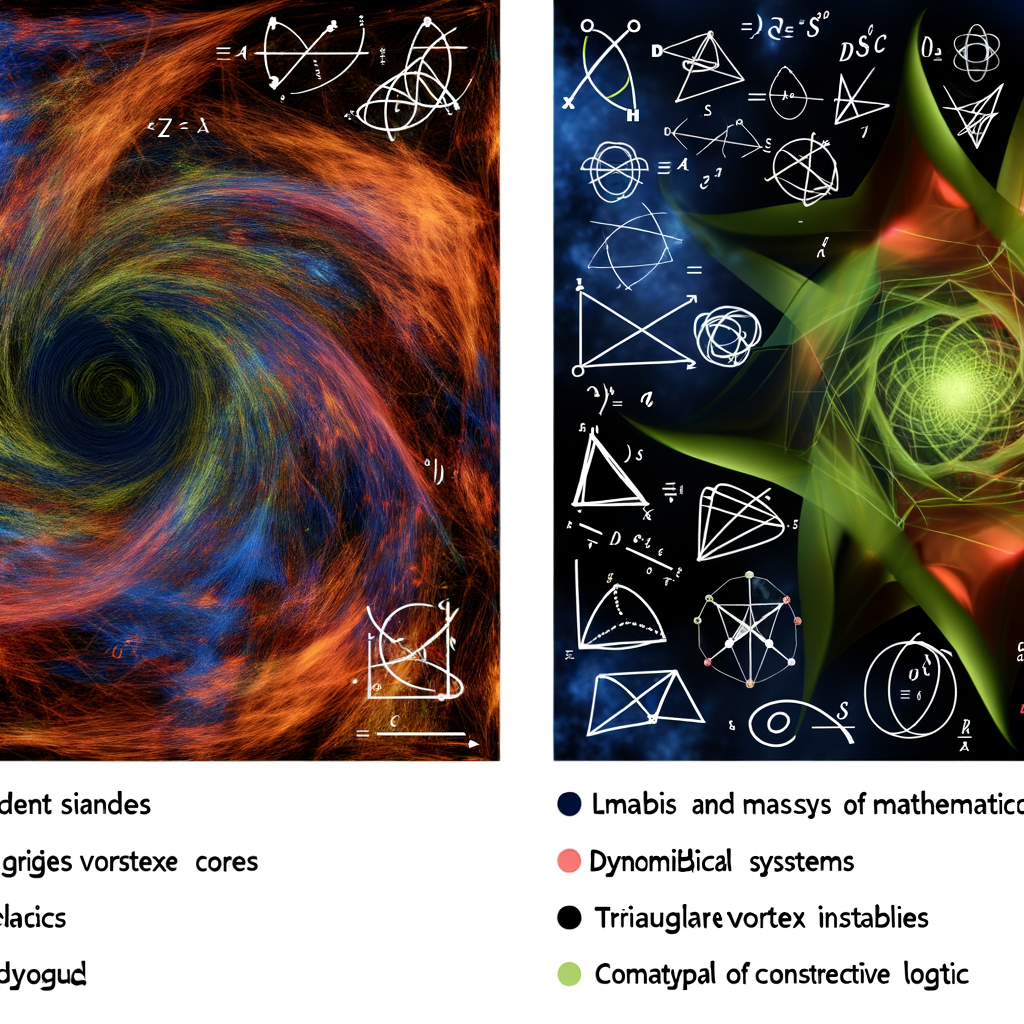
Let’s be blunt: physicists and engineers make beautiful contour plots because reality is too interesting to hide. A Lamb–Oseen vortex regularizes the r = 0 singularity with a Gaussian core; a strained Lamb–Oseen will, if you poke it the right way, spawn three satellite vortices and look like a tiny, angry triangle of chaos. Those pretty figures are not decoration — they are the data, the counterexample, and the debugging console all at once.
But what does it mean, mathematically, when the world refuses to be perfect? Pull up a stool — I’m Dr. Katya Steiner for this chatty intersection of fluids, logic, and a little bit of category theory mischief.
– Analysis and regularization: the grown-up compromise
In real analysis and PDEs, singularities are ideological problems: pretty on paper, lethal in practice. Regularization is the toolbox we use to make infinities manageable. Viscosity acts like a mollifier; boundary layers are the asymptotic expansions we cheat with; numerical schemes smuggle in implicit regularization via discretization. In other words: the ideal solution is a starting point, and analysis tells you how to deform it without losing the soul of the problem.
The Lamb–Oseen vortex is the textbook apology for the singular vortex: it keeps angular momentum and gives you a finite core. But regularization does more than remove infinities — it introduces structure that can be unstable. Suddenly the math that fixed your singularity creates new degrees of freedom where instabilities can grow. That’s not failure; it’s emergence, and it shows the modest heroism of applied analysis.
– Dynamical systems: where symmetry meets spite
Dynamical systems theory explains why a perfect circle won’t stay perfect. Symmetry breaking is the punchline: linear stability analysis hands you eigenvalues, and if one crosses into positive real parts, congratulations — you get a pattern. The triangular satellite vortices are a bifurcation story. Small perturbations become sustained patterns because the regularized core contains the modes that can resonate under strain.
This is why engineers care: coherent structures dominate transport, mixing, and drag. A tiny pattern can change macroscopic loss rates. So do not be fooled — the messy pattern isn’t a nuisance, it’s the physics delivering consequences.
– Topology and morphology: shape is not just shape
Topological thinking — invariants, connectivity, index theorems — gives us a vocabulary for qualitative behavior. A vortex core is a region with circulation; its topology determines how it can merge, split, or die. Tools like persistent homology (yes, the cool kid from TDA) let you quantify when a coherent structure is noise and when it’s meaningful.
Topology does not give numbers, but it gives robustness. If a pattern persists across thresholds and resolutions, it probably matters for the device you’re designing or the wake you’re trying to tame.
– Category theory (the pun is intended): functors that carry realism
Now for my favorite bit of nerdy theater: think of idealized models and their real counterparts as objects in different categories. A functor maps the perfect, symbolic world to the messy, experimental world. Regularization, numerical discretization, and measurement are all morphisms that preserve some structure and discard other bits.
Category theory asks: what structure do we insist must be preserved under this mapping? Conservation laws? Symmetry groups? Topological invariants? This perspective is delightful because it reframes “approximation” as a principled mapping problem. Instead of whining about loss, we say: what universal properties do we want the real model to satisfy?
Yes, it’s a high-level abstraction, and yes, sometimes it feels like using a jet engine to toast bread. But the payoff is conceptual clarity: it forces you to be explicit about what matters.
– Logic and proof styles: classical vs constructive lessons
How we prove things colors how we model them. Classical existence proofs that rely on non-constructive arguments can leave engineers stranded: a theorem says a solution exists, but doesn’t tell you how to approximate it. Constructive and computationally-minded mathematics are the ones that hand you algorithms and error bounds — the things that turn contour plots from curiosity into control.
Modal logic and counterfactual thinking also sneak in: “If I tweak the boundary condition this way, then the flow will that.” These are reasoning tools for design, and they reflect a shift from pure truth to robust, actionable prediction.
– Probability, randomness, and the honest confession of measurement
The beautiful regular patterns often sit atop a noisy background. Stochastic models and ensemble thinking help you separate signal from fluke. That three-vortex arrangement might be the deterministic bifurcation you predicted, or it might be the dominant mode of a noise-driven pattern formation. Either way, probabilistic thinking gives you confidence intervals for your awe.
– Pictures, persuasion, and practical ethics
Those heat maps, Mach contours, and electron-cloud plots do rhetorical work. A contour plot convinces faster than ten pages of inequalities. But there’s a responsibility: seductive images can hide assumptions — boundary conditions, grid resolution, turbulence models. As delightful as base bleed is for aerodynamicists, remember that clever hacks have social and ethical afterlives. The math is neutral; deployment is not.
— Balanced view, because nuance is sexy
The upshot? Math gives you lenses, not commandments. Analysis gives existence and regularization; dynamical systems explain pattern formation; topology speaks robustness; category theory reframes approximation as structure-preserving mapping; constructive logic hands you algorithms; probability quantifies confidence. Together they make the messy, photogenic world intelligible.
And let’s be honest: that mess is the fun part. If everything stayed ideal we’d be doing monotone operator theory in perpetuity and missing out on triangular hurricanes and electron galaxies.
So here’s where I leave you, with a slightly mischievous, academically affectionate question to tuck into your notebook between equations and memes:
If our models are functors from the idealized to the real, what properties must those functors preserve so that the pictures we love are not just pretty lies but robust guides to design and ethics? What are we willing to sacrifice to keep our maps useful, and what must we insist never be lost?
(Also: have you seen the latest contour plot of a strained Lamb–Oseen? It’s a whole mood.)
