The Categorical Imperative: Math, Bureaucracy, and the Talent That Keeps Getting Ghosted
 # The Categorical Imperative: Math, Bureaucracy, and the Talent That Keeps Getting Ghosted
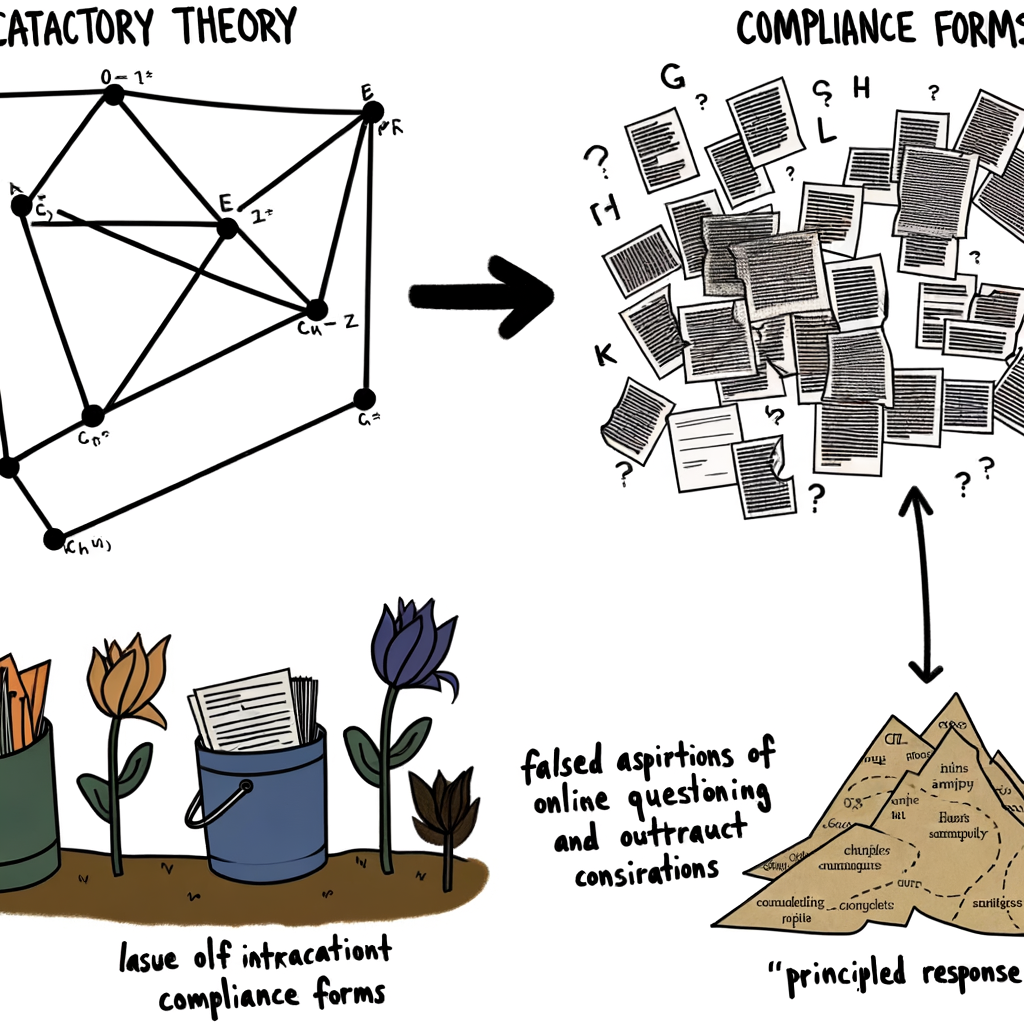
You want to ask a math question online, fix your career trajectory, or stop a brilliant kid from being elbowed out by red tape? Welcome to a place where category theory collides with compliance, and Kant hears about pushback forms. The scene is familiar: bright people, brittle policies, and a bureaucratic apparatus that seems allergic to nuance. Let’s be both candid and useful about how graduates — and the disciplines they love — can survive, and even shape, that mess.
## Ask like a mathematician (because you should)
The internet rewards precision. Vague prompts get philosophical sympathy; precise ones get usable answers. This is true whether you’re asking about manifolds or about whether to accept a teaching-track position that comes with a suspiciously vague job description.
– Start with your axioms: what do you already know? Linear algebra? Measure theory? Functional analysis?
– State the theorem you need, or the outcome you want: grad school, tenure-track prep, industry transition, or pedagogy.
– Give constraints: time, prior commitments, geographic or visa limits.
This is basic model theory of human help: the fewer free variables you leave, the more likely your interpreter will return a model that satisfies your constraints. Honestly, it’s like writing a good problem statement — and yes, that is the energy you should bring.
## Bureaucracy is not a proof — but it has lemmas
Universities and funders are risk-averse systems. That’s not evil; it’s risk management. But categorical bans — blanket background checks, zero-tolerance policies, refusal to fund travel — are blunt instruments that break promising constructions. A math circle disappears not because kids stopped liking combinatorics but because someone decided a 15-year-old can’t travel without an invoice that doesn’t exist.
Two sides here:
– The administration’s case: liability, reputational risk, and legal exposure are real. Institutions must be defensible in court and in the press.
– The community’s case: risk-avoidance often externalizes the true cost — lost talent, narrow pipelines, and wasted goodwill.
Practical middle paths exist. Instead of saying “no,” institutions can pilot supervised trips, accept third-party vetting, or require limited-duration credentials. Graduates who learn the language of compliance — and can map program goals to risk controls — gain leverage. Negotiation is not moral hazard; it’s engineering.
## Don’t make math beg for relevance (but don’t ignore applications either)
There’s an academic diet that insists every proof be Instagram-ready. That hunger for immediate utility flattens the subject. Math is training in abstraction: the ability to see structure, to craft definitions, to prove statements with elegance. Those are transferable skills even when the direct application isn’t obvious.
Still, applied math belongs on the table. The pedagogical balance is delicate:
– Teach the language and logic first. Let abstraction build muscle.
– Offer spectacular applications as motivation — Fourier transforms, eigenvectors, combinatorial designs — not as ransom.
– Use computational labs and data projects to bridge theory and practice without converting every proof into a sales pitch.
Both purity and pragmatism have value; the job is to hold them in productive tension rather than flattening one into the other.
## Cross-sections: discipline-specific takes
Category theory: The sheer abstraction can look like ivory-tower indulgence. But its patterns — functors, natural transformations — give you the meta-linguistic tools for portability. If you can reframe a problem categorically, you often see the invariant that makes different applications the same problem in disguise.
Set theory & logic: These are the foundations we sometimes forget about. Model theory and proof theory teach you how to reason about systems of rules — which is exactly what you need when you argue with administrators who are convinced their checkbox satisfies all models of safety.
Topology & geometry: They train spatial intuition. In careers, that intuition helps you navigate networks of people and institutions: who’s connected, where the holes are, and what covers can be patched.
Statistics & numerical analysis: These are the workhorses. They make you employable and let you translate clean theorems into robust approximations when the world refuses your ideals.
Each area gives you a distinct logic; use them to read institutions, not just problems.
## When governments ghost talent
A 15-year-old aces the exam but can’t get a visa or travel funding. That feels like existential bad faith. The community’s response matters: amplify, connect, crowdfund, mentor. A few concrete steps:
– Amplify with evidence: public attention with named institutions tagged, not just moral outrage.
– Connect through networks: departments, NGOs, or foundations that sponsor travel or fees.
– Crowdfund transparently with endorsements; sometimes money is the nudge an institution needs.
– Mentor remotely: a single recommendation letter can be the pivot that opens a door.
These are small acts of local engineering that can bypass planetary-scale inertia.
## A pragmatic playbook for grads
– Create a “question template”: background → goal → constraints → attempts.
– Maintain an administrative playbook: background checks, liability concerns, and common institutional language.
– Have two CVs: a concise academic narrative and a skills-forward industry version.
– Invest time in advocacy. One well-argued email that maps policy to human cost is often worth ten protests.
## Closing (and a small, mildly indignant aside)
Math is a set of tools and a way of being. The categorical imperative I propose is simple: act in ways that preserve both the discipline’s intellectual integrity and its pathways to practice. Defend abstraction when it matters; hustle bureaucracy when it blocks people. The world will keep inventing new ways to ghost talent — forms, firewalls, fiduciary pretexts — but the counterstrategy is always local, relational, and a little bit annoying.
So I’ll end with a question that’s equal parts philosophical and tactical: when you spot a talented person being sidelined by policy, do you sit back and write a stern Slack message, or do you learn the institution’s logic well enough to out-engineer it? Which do you choose next time you see the lights going out on a promising program?
